
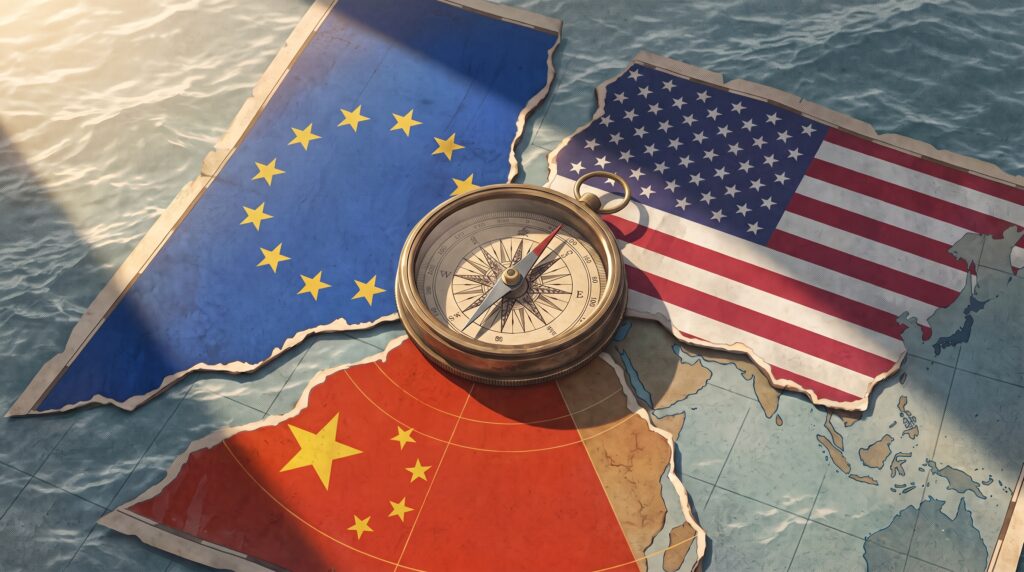
In 2026, ESG became a mirror of power struggles between trading blocs, well beyond regulatory compliance. Washington treats EU directives as trade barriers, while Beijing builds legal tools against foreign due diligence. Yet on reporting, the three blocs converge more than is often assumed, including on double materiality between Europe and China. EU groups operating abroad, US groups established in Europe, Chinese groups in Europe and European groups in China all sit on these fault lines. Here is a map of the convergences and divergences, and practical principles for navigating them without losing integrity.
1. A three-pole map: converging reporting, fractured due diligence
In Business in 2026: Why Ethics Helps to Navigate Complexity, we noted that geopolitical fragmentation was accelerating in 2026, disrupting international operations and the assumptions behind strategic planning. To make sense of it, two arenas must be separated, because they are moving in opposite directions. On reporting, the blocs are converging. On due diligence, they are clashing.
On reporting, convergence is broader than it looks. Europe, through the ESRS, and China now share a structuring principle: double materiality. Since 2026, large Chinese companies in the SSE 180, STAR 50, SZSE 100 and ChiNext indices, along with dual-listed companies, must publish sustainability reports. The Chinese exchanges’ guidelines require companies to assess both how sustainability issues affect the business and how the business affects the economy, society and the environment. In parallel, as the IFRS Foundation’s jurisdictional snapshot describes, China’s Ministry of Finance has laid the foundations of a unified national system that draws on the ISSB.
Our analysis China’s Climate Standard: CSDS in Action showed that this hybrid approach brings China closer to both the ISSB and the CSRD: aligned with ISSB, but with distinctly Chinese features around impact materiality. Most other large economies are converging on the ISSB baseline: according to S&P Global, 28 jurisdictions had adopted it by 22 April 2026, and 12 more were planning to do so.
The US divergence. The United States is the exception. In official comments published by the US Mission to the EU, Washington explicitly contrasts its strictly financial materiality with Europe’s double materiality. The gap is not new. In our analysis of key areas to scrutinise in the ISSB and EFRAG consultations, we observed that the SEC’s focus was mainly on governance and the environment, while EFRAG set out a broader societal project aimed at a fairer, more sustainable economy.
On due diligence, an open rift. Due diligence is where the blocs clash. For Washington, the issue is trade. In the EU–US joint statement of 2025, the EU committed to ensuring that the CSDDD and CSRD would not unduly restrict transatlantic trade. A year later, Washington considers the Omnibus insufficient and threatens to take any necessary action. The pressure extends to energy: the US Energy Secretary and Qatar’s Energy Minister, in a joint letter, called on the EU to repeal the CSDDD or remove its most damaging provisions.
For Beijing, the issue is sovereignty. In spring 2026, China’s State Council adopted two regulations: Decree 834 on supply chain security and Decree 835 against improper foreign extraterritorial jurisdiction. Both took effect immediately. The Global South, for its part, contests unilateral measures: the BRICS New Delhi Declaration of September 2026 opposed the EU’s carbon border adjustment mechanism and other unilateral measures impeding trade.
A multilateral vacuum. No forum now coordinates these developments. The US G20 presidency has made reducing regulatory burdens its priority, and the first 2026 meeting of G20 finance ministers ended without a joint statement.
2. Four company profiles, four exposures
This map translates into very different exposures depending on where a group is headquartered and where it operates.
The EU group operating outside the EU. Its exposure stems from the reach of the rules it applies. The Omnibus narrowed the CSDDD to very large companies: EU companies with more than 5,000 employees and over €1.5 billion in worldwide net turnover. For groups still in scope, obligations continue to cover their global chains of activities. Member states must transpose by 26 July 2028, and companies must comply from 26 July 2029.
As we analysed in CSDDD Under Siege: Why Business Divides on Regulation, the Omnibus narrowed value chain coverage. In-depth assessments of indirect partners now require “plausible information” of adverse impacts, and many companies responded by adopting wait-and-see postures. In a fragmented world, the directive’s original ambition of a level playing field has become costlier to uphold.
The US group with major EU operations. Its exposure is the reverse. Wave 2 companies, including EU subsidiaries of US groups, begin reporting in 2028 on financial year 2027. Wave 3, covering non-EU companies with more than €450 million in EU turnover, follows in 2029. The difficulty is political: producing double materiality reporting in Europe while its own government contests the principle.
Our comparison of SEC rules with CSRD/ESRS and IFRS showed that a common baseline is possible, provided it is owned. It also noted that the CSRD insists on the means companies deploy to make progress on identified risks, an expectation absent from the US rules. If Brussels granted the “presumption of conformity” Washington demands, the level playing field would tilt against European groups. The CSDDD amendments, on which Ksapa was asked to share practitioner feedback with EU policymakers, show how contested this balance remains.
The Chinese group established in the EU. On reporting, its step up is smaller than for a US group: its reports in China already apply double materiality (on climate related impacts only though). But product-related deadlines are approaching:
- The EU Forced Labour Regulation takes full effect on 14 December 2027, with no country or industry exemptions.
- The Batteries Regulation‘s due diligence obligations apply, according to the Council of the EU, from 18 August 2027. They directly concern Chinese battery makers operating in Europe.
This group also faces a paradox. Its EU subsidiary must conduct due diligence on its own supply chain in China, while Decree 834 requires every organisation within Chinese territory to execute the measures taken under it. The political climate weighs too. According to the 2025/2026 report of the China Chamber of Commerce to the EU, 81% of surveyed companies perceive rising unpredictability, and more than 40% report differential treatment. Beijing has responded on legal terrain: in its first formal determination under Decree 835, China’s Ministry of Justice deemed the European Commission’s Foreign Subsidies Regulation investigation into Nuctech an improper extraterritorial application of foreign law.
The European group established in China. This is the profile most exposed to conflict of laws. The CSDDD and the US UFLPA require investigating supply chains in China; Chinese law now restricts precisely that investigation. Three friction points stand out:
- Audits and questionnaires. Conducted for CSDDD purposes, they conflict with Decree 834’s restrictions on information gathering.
- Ending relationships. Restricting or severing ties with a Chinese counterparty to comply with a foreign requirement can trigger exposure under the decrees.
- Group policies. A global policy requiring Chinese subsidiaries to automatically comply with foreign sanctions may be viewed unfavourably.
The European Union Chamber of Commerce in China warned that vague provisions in Decree 834 increase the risk of doing business in or with China. Yet dependencies persist: operational and commercial ties to China continue, even as companies grow warier of committing fresh capital.
3. Navigating between blocs: six principles
The temptation is to wait for the rules to settle. That is the riskiest option: existing obligations do not disappear, and undocumented trade-offs become indefensible. Here are six principles for building on convergence and managing divergence.
First principle: build on convergence, manage divergence. Producing separate reports per jurisdiction is costly and breeds inconsistency. As our comparison of Chinese Sustainability Disclosure Standards with CSRD and ISSB highlighted, the Chinese standards emphasise double materiality on principles similar to the CSRD. The rational path is therefore a single data architecture. It combines an ISSB-aligned core, shared by most major economies, with an impact layer required in Europe and now recognised in China. That layer calls for rigorous mastery of double materiality. The ESRS simplification, which strengthens interoperability with the ISSB, makes this approach easier.
Second principle: one narrative, owned before every audience. Telling a sustainability story in Brussels, a financial performance story in Washington and a sovereignty story in Beijing is untenable in an age of transparency. The line must be set at the highest level of governance. Our analysis of CSRD simplification under the Omnibus package argued for focusing on genuinely material topics rather than disclosure for its own sake.
Third principle: map conflicts of law and document every trade-off. Risk mapping must now include a legal dimension: where does a European or US obligation collide with a Chinese prohibition, and vice versa? Our country sourcing risk mapping guide sets out an integrated approach producing holistic risk profiles that reveal systemic vulnerabilities rather than isolated data points. When conflicts arise, traceability is the best protection: legal basis, advice received, alternatives considered, decisions taken and compensating measures. The same file must be able to demonstrate proportionality to a European authority and the absence of discrimination to a Chinese one.
Fourth principle: rely on published information and dialogue where auditing becomes sensitive. The reports that large listed Chinese suppliers now publish under their own regulator’s oversight are a source of information that does not involve collection by a foreign entity. This is an avenue to be validated legally case by case. Where third-party audits become risky, invest in stakeholder dialogue, grievance mechanisms and supplier support. As we wrote in Why Due Diligence Demands Real Dialogue, due diligence laws themselves demand meaningful stakeholder engagement. Mediation offers a less adversarial route, as discussed in Due Diligence: Mediation, an Effective Alternative.
Fifth principle: use the value chain cap wisely. The cap introduced by the Omnibus protects suppliers with 1,000 employees or fewer without prohibiting broader requests. According to the European Commission, a company may request more than the voluntary standard, provided it flags such requests and informs the supplier of its right to decline. In sensitive jurisdictions, staying within the voluntary standard reduces the data collection footprint. More detailed requests can be reserved for salient risks.
Sixth principle: shape the debate rather than endure it. The CSDDD guidelines, the ESRS for third-country groups and the implementing texts of the Chinese decrees are still being written. The European Chamber in Beijing and the China Chamber of Commerce in Brussels are currently the most active channels on these conflicts of law. Raising concrete, documented difficulties through them is more effective, and less exposed, than acting alone.
Ultimately, fragmentation does not make ESG obsolete: it changes its nature. Reporting is converging into shared infrastructure, while due diligence is becoming politicised terrain for sovereignty. The groups that fare best will hold a consistent line, anchored in recognised references such as the OECD Guidelines for Multinational Enterprises, rather than trying to satisfy each bloc separately.
Ksapa supports international groups in building integrated ESG architectures, mapping regulatory conflicts and designing due diligence systems adapted to sensitive contexts. Contact us.
Image by Runway

CEO and Co-Founder of Ksapa. Member of sustainability boards at major industrial groups and impact investment committees. Drawing on 25 years of experience working with multinationals, mid-size and small businesses across value chains, governments, and international organizations, Farid Baddache focuses on integrating human rights, climate, and ESG governance as drivers of business resilience and competitiveness. Author of several books on sustainability and responsible business. Connect on Bluesky @faridbaddache.bsky.social