Most agricultural carbon projects are designed backwards. They start from a volume of credits, then reorganise the farm to produce it. Farmers rarely come first in that logic. In RegenCC, our regenerative coconut project in the Philippines, we reverse the order: the agronomic system comes first, and carbon finances it. The reason is a question of timing.
Why carbon revenue cannot anchor farmer adoption
A coconut farmer in Quezon Province harvests roughly every 45 days. That cycle pays for school fees, fertilizer and transport to the health centre. Household spending is organised around it.
Carbon revenue follows a very different schedule indeed, credits are issued only after biomass is measured, validation and verification bodies visit the site, and the registry records the result. Verification follows established MRV protocols and runs over several years. Between a change in practice and the first carbon payment, years can pass.
This creates a practical problem that is often underestimated. Smallholders exposed to climate change are often said to have an incentive to adopt new practices. But exposure and capacity to take risk are not the same thing. A household with no buffer cannot absorb a failed trial. If a new crop fails, the loss is a year of school fees, not a line on a balance sheet.
The conclusion is quite simple: If carbon revenue is the only reason to change practices, adoption will be low and retention lower. So we designed the system to work without it. Carbon finances the transition instead. This reflects a position Ksapa set out at COP28: farmers’ benefits must far outweigh their share of credit sales.
Start from the coconut smallholder baseline
Philippine coconut smallholders are among the poorest producers in one of the country’s largest export sectors. A Grameen Foundation baseline study in the Davao region found average yearly farm income of about PHP 38,700 (USD 754) on holdings averaging 2.3 hectares. The Livelihoods Fund estimates that around half of Filipino coconut farmers live on less than USD 2 a day. Most lack the training or capital to replant ageing palms. Many trees are now senile, so yields keep declining.
Several factors have deepened grower vulnerability in recent years. Revenue comes from a single crop cultivated in a monoculture system, sold to a single type of buyer, on a single cycle. Soil fertility is declining. Irregular rainfall hits yields. There is no second source of income when something goes wrong. In this sector, something goes wrong regularly: a typhoon, a scale insect outbreak, or a copra price that falls sharply between two harvests.
A carbon project has an opportunity here that is often missed. Practices that sequester carbon in a coconut system are largely the same ones that diversify income and restore soil. If the design is built around that overlap, sequestration follows from the agronomy. It is not imposed on top of it. As SAI Platform notes, regenerative sourcing in smallholder supply chains is still hard to launch, which makes this overlap all the more valuable.
Biomass relays at the centre of the system
Everything in the system runs through what we call biomass relays. These are successive layers planted under and around the coconut palms. Each layer adds biomass to the plantation. Each one also opens a new source of income for the farmer. The approach builds on Ksapa’s work on regenerative agriculture transitions.
Biomass relays do two jobs at once. First, they build soil. Leaf litter, prunings and mulch return organic matter to the ground, improve fertility and help the soil hold water. Second, they diversify revenue. Intercrops create cash flows that do not depend on copra prices alone.
Crops are chosen for complementary timing. Some produce within the first year and carry the household while others mature. Longer-cycle cash crops then add a durable income stream. All of them benefit from the richer soil the relays create, and so do the palms.
The practical consequence is that the agronomic gains stand on their own. A farmer who adopts it and never sells a single carbon credit still gains better soil, more diverse income and a lower fertiliser bill.
This gives a useful test for any design of this type. If the intervention only makes economic sense once carbon revenue is added, it is not robust enough to ask a household to adopt.
Stage the conversion so no household is exposed
The second design principle concerns pacing rather than agronomy. It is the one most often neglected.
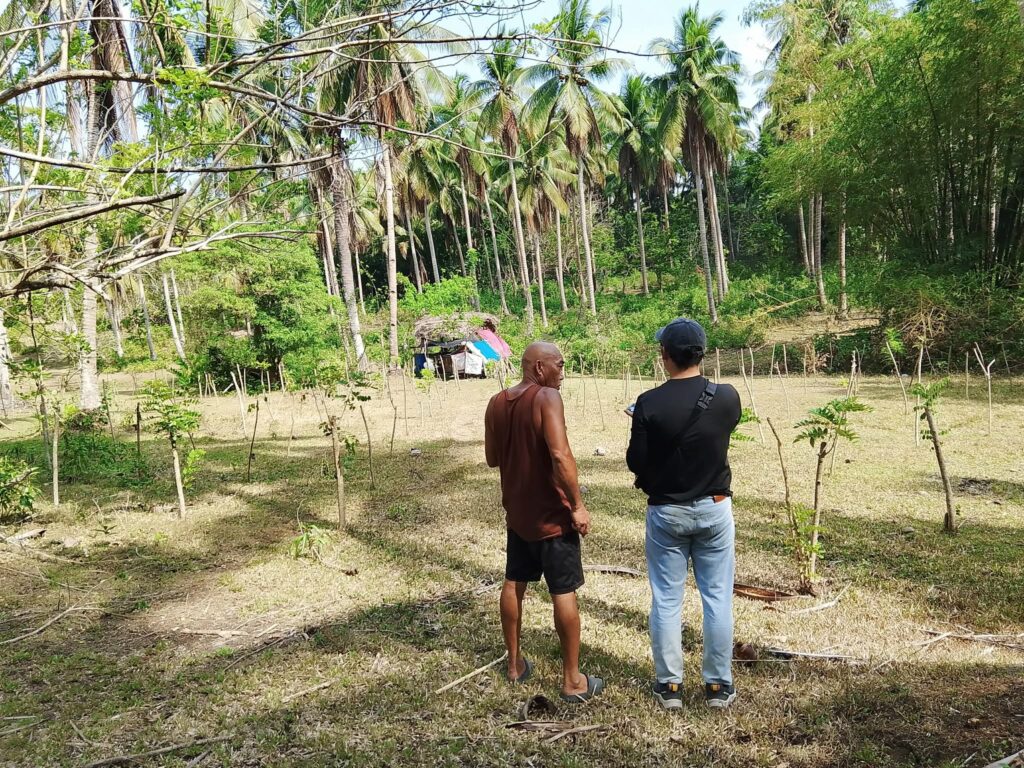
We do not convert a whole farm in one operation. The farm is worked in small blocks, planted in successive phases. The farmer is free to stop at any point. The first block goes on the most favourable land. Farmers then extend at their own pace, using the planting material and know-how they have already acquired.
The reasoning is simple: projects lose participants between planting and first return. Longer-cycle cash crops take several years to come into production. If a farmer converts the whole holding in year one, year two becomes a gap in household income. That gap is when people leave the programme, sell land, or borrow from the trader who buys their nuts. This often leaves them worse off than before they joined.
Staggering the conversion means mature production is always carrying the household while new areas establish. It slows the project down. That is an acceptable cost. Field officers and a digital companion app support farmers between phases.
The two roles carbon finance actually plays
Within this structure, carbon finance performs two specific functions. Each deserves a precise look. Ksapa has long argued that digital tools can bridge carbon finance and smallholder farming.
The first is financing the conversion itself: nursery, training, field officers, planting material, and support through the years before longer-cycle crops produce. These are real costs. No smallholder can pay them upfront. No buyer will absorb them without something in return. Our SUTTI training programmes are built to deliver this support at scale.
The second concerns the buyer. Land-based removals only count toward a company’s SBTi FLAG target if the land can be shown to sit within that company’s value chain. Accounting follows the GHG Protocol Land Sector and Removals Guidance. This is why geolocated plots and farmer-level records are as important as the trees themselves. The traceability layer is not administrative overhead. It is the mechanism that lets a processor justify funding work on land it does not own. SUTTI’s farmer-level traceability makes that link legible.
The buyer wants secured supply and a defensible reporting claim. The farmer wants a holding that survives a difficult year. The same interventions serve both objectives. That convergence is what makes the model fundable at scale. It is also how companies turn climate commitments into value chain action.
Three principles to carry into other designs
– Build the system to stay economically sound even if carbon revenue never materializes. Otherwise, the project asks farmers to carry the risk on behalf of its financiers.
– Convert land in stages so no household is ever fully exposed during establishment. Use small blocks, planted in phases, with a genuine right to stop.
– Position the first economic return as early as possible. A short-cycle crop in year one does more for retention than a perennial in year three. The first year is when participants decide whether the programme is credible.
Carbon projects are measured in tons because tons are what a registry can count. But what keeps a project standing in twenty years is simpler. Does the farmer who planted the first block still have a reason to tend it in year eight? When the coconut price falls and a typhoon destroys part of the crop, are there other crops to sell and soil that still holds water?

Hatim Issoufaly has for the past 15 years been passionated about strengthening the capacity of local development actors to achieve impact at large scale. Structuring resilient supply chains through innovative agronomic models and social structuration, enabled him to increase the net revenue of farmers while improving the quality and traceability of high risk commodities.
Hatim speaks French, English, Spanish, Bahasa Indonesia and Hindi. He holds a Master Degree in Comparative agricultural system (Agro Paristech) and a Tropical Agriculture Master degree from Montpellier School of Agronomy.