
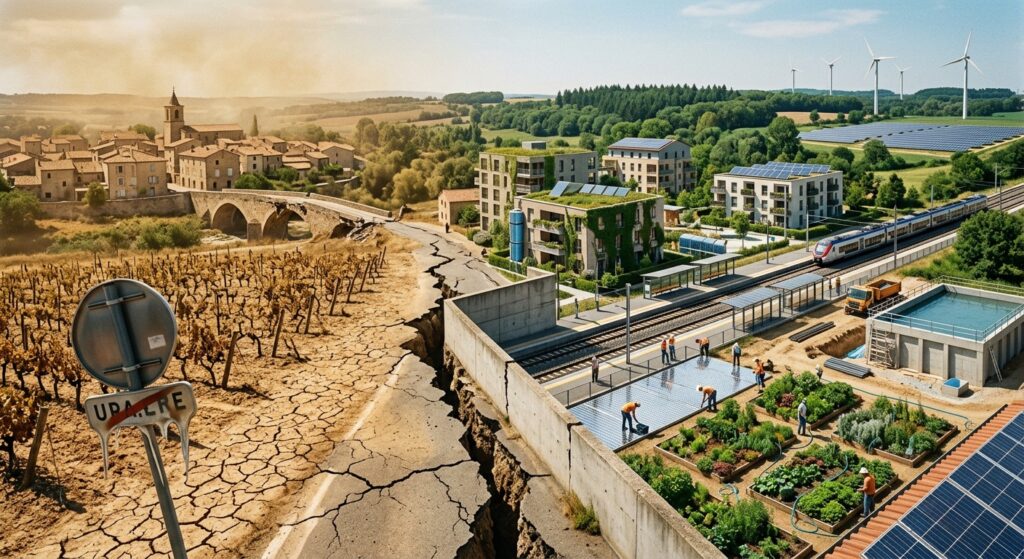
A heat wave that fries electrical transformers, swamps hospitals, and dries up rivers. This isn’t a forecasting scenario for 2050. It’s what swept across Europe in late June 2026. Germany posted a new national all-time high of 41.5°C (106.7°F), as confirmed by the country’s national weather service and reported by Al Jazeera, breaking a record that had itself been set just one day earlier. Denmark recorded its hottest day since record-keeping began in 1874, hitting 37°C (98.6°F), while the Czech Republic, Switzerland, the United Kingdom, France, and Italy all broke their own June or all-time temperature records within the same week. Close to 200 million Europeans were exposed to temperatures above 35°C in a single day. The full country-by-country breakdown, including death tolls and infrastructure failures, is tracked on Wikipedia’s page on the 2026 European heatwaves. This wasn’t an isolated continental event, either. As CBC/AP reported, records fell “from Switzerland to the Czech Republic and Denmark” within days of each other, overwhelming health systems in cities where air conditioning remains the exception rather than the rule. Scientists quoted by RTÉ concluded that the heat wave’s night-time temperatures were made roughly 100 times more likely by human-caused climate change than they would have been just two decades ago driven by an “omega block” weather pattern that traps a dome of hot air in place for extended periods.
Other regions of the world have already lived through episodes of comparable or even greater intensity: the 2021 Pacific Northwest heat dome, the deadly 2022 and 2024 heat waves across India and Pakistan, the 50°C readings recorded in the U.S. Southwest in 2023, and the catastrophic floods that submerged a third of Pakistan’s territory. The “Heat Dome” pattern parked over Central Europe in 2026, described in detail by meteorologists at Severe-Weather.eu, struck “even harder than any predictive model anticipated”. A phrase that could describe nearly every major heat event of the past five years. Each of these episodes functions as a real-world stress test. And the diagnosis is unambiguous: infrastructure, supply chains, insurance models, and public policy were all designed for a climate that no longer exists. Climate scientists increasingly agree on a blunt point: The climate in which our societies, economies, and supply chains were built has already disappeared. Yet the gap between the pace of warming and the pace at which our systems adapt keeps widening. A lag that can reasonably be measured at a full decade relative to what the emissions trajectories already known in the early 2010s would have required. This observation leads to a double conclusion, as simple as it is uncomfortable. First, it is an illusion to think we can adapt to a 3°C or 4°C warmer world without drastically and immediately cutting emissions: adaptation without strong mitigation is a losing bet. Second, the persistent inconsistency of public policy (e.g.: subsidizing the decarbonization of a single petrochemical site while cutting the budgets meant to fund municipal climate transitions, or financing ambitious climate plans without any binding regulatory teeth) can no longer serve as an excuse for corporate inaction. That second point is where this piece wants to focus attention: where the political pillar remains erratic or simply absent across most of the world’s major economies, it falls to companies, their value chains, and local multi-stakeholder coalitions to pick up the pace without waiting for a political alignment that keeps failing to materialize.
1. Adaptation Without Strong Mitigation Is a Dead End Everywhere
The trap that many governments fall into is presenting adaptation as a self-sufficient policy, disconnected from efforts to cut emissions. That’s a reasoning error with very real consequences, and it isn’t confined to Europe.
Within Europe itself, the late-June 2026 heat wave exposed the limits of existing adaptation measures wherever they were tested. Emergency services were overwhelmed in cities like Cologne after ten consecutive days of extreme heat with no meaningful overnight cooling, while hundreds of deaths were recorded across Spain, France, and other parts of the continent, and several nuclear reactors had to be shut down in both Switzerland and France because river water had grown too warm to use for cooling. In the Netherlands (a country that has spent decades pioneering flood adaptation hence its name…) authorities themselves now acknowledge that sea-level-rise scenarios beyond two meters render obsolete the dike strategies built on the assumption of contained warming. In Phoenix, Arizona, massive investment in cool roofs and air-conditioned cooling centers hasn’t stopped heat-related mortality from climbing for five straight years, because the intensity and duration of heat waves now routinely exceed the parameters those systems were designed around. In Bangladesh, early-warning systems for cyclones – long held up as a global model for adaptation – save lives but no longer protect farmland from the salinization caused by rising seas, a process accelerating faster than the models used a decade ago predicted.
The common thread running through all these situations is the same one visible in the European heat wave: systems are adapted to a predefined “extreme” climate, and reality routinely exceeds that definition. Every “unprecedented” heat wave becomes the new floor, not the ceiling whether in Paris, Berlin, Copenhagen, or Phoenix. This is the very nature of climate drift: a succession of events that, by definition, have never had a historical equivalent and that then recur, more frequently and more severely.
For businesses, the lesson is direct. A business continuity plan calibrated to the most severe climate event observed to date is already obsolete by the time it’s signed off. Physical climate risk analyses need to incorporate scenarios that exceed historical baselines. Something some international insurers and reinsurers are already doing by revising risk pricing models annually rather than every five years, and that some food and agriculture companies are doing by stress-testing their supply chains against simultaneous disruption across multiple sourcing regions (West African cocoa, Southeast Asian rubber, Latin American coffee) rather than a single hazard at a time. This logic of mapping critical dependencies well beyond Tier 1 suppliers is exactly what Ksapa lays out in its analysis of the new geopolitics of critical supply chains, which points to a persistent “cognitive blind spot” in corporate culture: the systematic underpricing of supply chain vulnerability, even when the underlying risks have been documented for at least a decade.
This logic of dual acceleration – cutting emissions while simultaneously preparing for shocks more severe than any observed so far – isn’t an intellectual luxury. It’s an operational survival condition that now needs to structure risk governance across every sector exposed to globalized agricultural, energy, and industrial value chains.
2. When Public Policy Stalls, Business Has to Accelerate on Its Own
Climate policy remains strcuturally incoherent. Significant public resources continue to flow toward carbon-intensive assets even as budgets for municipal transition and public research shrink. This kind of contradiction has no exception. It shows up in the fossil fuel subsidies that persist across many G20 economies despite successive climate summit commitments, and in the slowdown of several EU sustainability regulations (CSDDD, the green taxonomy) under pressure from industry lobbying in the name of short-term competitiveness. This is exactly the diagnosis Ksapa drew coming out of COP30: companies can no longer wait for comprehensive multilateral frameworks, while diplomatic consensus continues to lag well behind climate urgency.
Faced with this instability, some companies have stopped waiting for regulatory clarity to act. Not out of virtue, but out of economic necessity. Several large food and chemical groups have adopted internal carbon prices well above regulated market prices, steering investment toward decarbonization regardless of political headwinds. International retailers have launched water-resilience plans at critical logistics sites across South Asia and East Africa, anticipating restrictions local authorities haven’t yet formalized. In the natural rubber sector, programs bringing together manufacturers and smallholder farmers across Southeast Asia have begun embedding heat- and water-stress adaptation criteria into sourcing specifications, without waiting for an equivalent regional regulatory mandate. An approach close to the three-step methodology Ksapa proposes for onboarding suppliers into a 1.5°C climate strategy, precisely because voluntary approaches haven’t yet demonstrated sufficient impact at scale over the past decade.
This movement remains a minority and is still insufficient in scale, but it points in a clear direction: the materiality of physical climate risk to assets, supply, labor, insurability is becoming a more powerful management argument than waiting for an ideal regulatory framework. In some sectors, finance teams and risk committees are starting to factor climate scenarios into capital-allocation decisions independent of any legal requirement, simply because the cost of inaction (e.g.: production interruptions, soaring insurance premiums, lost social license to operate) now exceeds the cost of acting early. That’s precisely the spirit of the OECD-anchored roadmap Ksapa lays out for climate action that COPs fail to clarify, which encourages companies to go beyond mitigation alone and invest in resilient infrastructure while diversifying supply chains.
This requires a shift in posture for many organizations: stop treating climate as a regulatory compliance issue to be minimized, and start treating it as a business continuity and long-term competitiveness issue. Companies that wait for a coherent political signal before investing in mitigation and adaptation take on a greater strategic risk than those that move forward and adjust course later. In a context where many governments seem comfortable with a degree of structural inaction or inconsistency between rhetoric and budgets, this private-sector pillar becomes, in effect, the main lever of acceleration available in the short term.
3. Local Coalitions and Multi-Stakeholder Hubs as the Relay
The third lever, complementary to individual corporate action, is territorial and multi-stakeholder coalitions that route around national gridlock by acting at the local or regional level, where proximity between businesses, municipalities, and communities allows for faster coordination than national-level deal-making.
C40 Cities, through its Cool Cities Network and its newer Cool Cities Accelerator launched at the November 2025 World Mayors Summit in Rio de Janeiro, has shown, across contexts as different as Medellín, Freetown, and Phoenix, that a coalition bringing together municipalities, local businesses, funders, and community organizations can deploy adaptation solutions faster than a national framework, precisely because it relies on blended finance and shared governance rather than a single layer of political decision-making. The International Federation of Red Cross and Red Crescent Societies makes the same point in its joint statement with C40: heat-wave deaths are not inevitable once early-warning systems and local preparedness are taken seriously. In West Africa, programs the like IREN AGRI are bringing together cocoa manufacturers, development finance institutions, and farmer organizations leveraging blended-finance mechanisms for agroforestry and income diversification. In the Philippines, partnerships between agribusiness companies, cooperatives, and provincial authorities in the coconut sector are piloting carbon-payment and climate-resilience models at the scale of a single production basin.
What makes these territorial hubs effective is their ability to align concrete, short-term interests (e.g.: securing a supply chain, protecting an asset, sustaining local employment) with long-term climate objectives, without depending on a national political consensus that’s often out of reach within the necessary timeframe. They also make it possible to pool the cost of data and monitoring (e.g.: measuring impact, verifying commitments, harmonizing reporting) among actors who individually wouldn’t have the capacity or the appetite to invest alone in these systems.
This is the direction the most advanced organizations are now taking: not waiting for a coherent political signal that keeps failing to arrive across too many geographies, but instead building operational coalitions at the scale of territories and value chains, where mitigation and adaptation can advance together and be measured jointly.
Conclusion
The heat wave that just gripped Europe is only one signal among many, part of a worldwide series of events that systematically exceed the frameworks built to anticipate them. The World Meteorological Organization has said it is “possible” this episode represents an unprecedented event in scale, while reiterating that recurring heat waves remain an unambiguous marker of human-driven climate change. The conclusion that follows is clear and shared well beyond Europe’s borders: without a drastic and immediate cut in emissions, no adaptation strategy, however well-funded, will be able to keep pace with warming. And as long as political decision-making remains marked by inconsistency or inertia, it will fall to companies, their value chains, and multi-stakeholder territorial coalitions to accelerate. Not as a posture, but because the cost of inaction now far exceeds the cost of acting early. The time lost over the past decade won’t be recovered through simple technical adjustments; it calls for a change in scale and pace, starting now, wherever actors are ready to move.

CEO and Co-Founder of Ksapa. Member of sustainability boards at major industrial groups and impact investment committees. Drawing on 25 years of experience working with multinationals, mid-size and small businesses across value chains, governments, and international organizations, Farid Baddache focuses on integrating human rights, climate, and ESG governance as drivers of business resilience and competitiveness. Author of several books on sustainability and responsible business. Connect on Bluesky @faridbaddache.bsky.social