
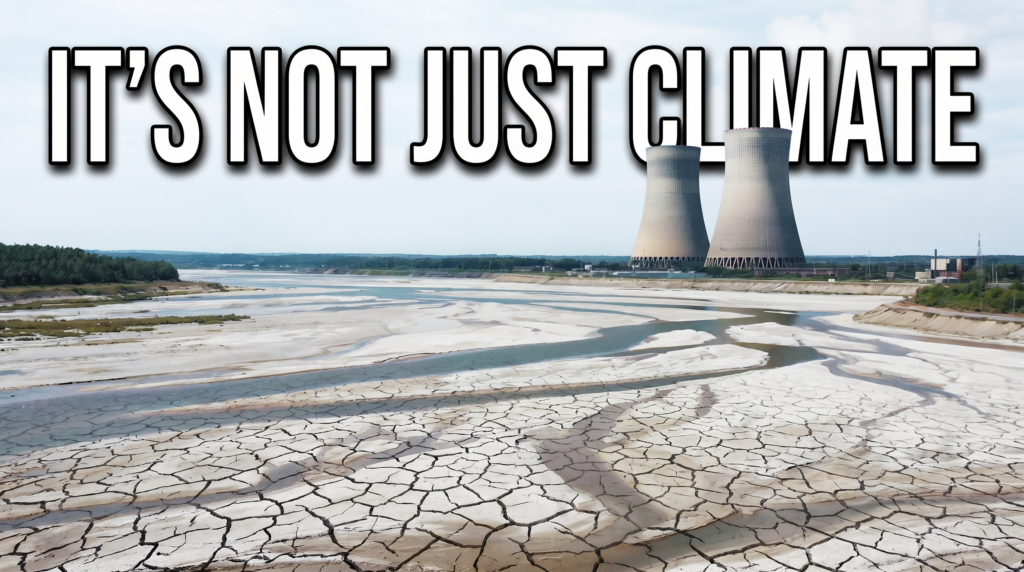
The summer of 2026 will be remembered as a turning point in Europe’s hydrological history. In Budapest, the Danube fell so low that Hungary’s only nuclear plant was forced to power down, cutting the country’s electricity output nearly in half for the first time in the facility’s forty-four-year history. A few hundred miles away, the Rhine broke its own temperature records and saw its flow drop roughly a fifth below the already severe drought of 2022. Farther north, Poland’s Vistula River hit a historic low not seen since 1952. From Portugal to Scandinavia, the Copernicus European Drought Observatory has been tracking near-continuous alert conditions since spring.
Faced with this continent-wide picture, the reflex explanation comes almost automatically: climate change. It is, without question, a major aggravating factor — attribution studies leave little doubt about that for the summer of 2026. But reducing Europe’s water crisis to climate alone ignores what the data have been showing for far longer. The European Environment Agency estimates that roughly 30 percent of EU territory and a third of its population are already affected by water stress in an average year — a condition documented well before 2026 became a record-breaking one. Climate change is amplifying a fragility that Europe built for itself, through decades of land-use, agricultural, and industrial choices. It is that structural fragility, not the weather alone, that needs examining if the continent hopes to move past permanent crisis management.
A Continental Crisis That Goes Well Beyond Weather
What stands out about the 2026 drought is its geographic reach. It is hitting, simultaneously, countries with very different climates, farming systems, and water infrastructure — from England, which just recorded its driest July on record, to Switzerland, where some monitoring stations are logging flows only seen once a century, to Germany, the Czech Republic, and Hungary. That uniformity across the continent is a strong invitation to look past national particularities and identify shared causes running deeper than a single year’s rainfall anomaly.
The European Environment Agency’s flagship five-year assessment makes the point unambiguously: even though water withdrawals across Europe have fallen somewhere between 14 and 19 percent since the early 2000s, the share of territory affected by seasonal water scarcity has not declined. In other words, Europe has become more water-efficient while remaining just as vulnerable — clear evidence that the problem isn’t purely a matter of volume, but a structural one: paved-over soils that can no longer absorb rainfall, wetlands drained generations ago, and rivers straightened and channeled until they lost their natural capacity to regulate temperature and flow. As one hydrologist at the University of Strasbourg put it regarding the Rhine, a river turned into a “highway” heats up faster and self-regulates far less than one still allowed to meander.
This structural dimension explains why infrastructure built for a more stable world is now hitting its limits. The Paks nuclear plant is a textbook case: designed to draw cooling water directly from the Danube rather than rely on closed-loop cooling towers, it was built on the assumption of a river “too mighty to run dry.” That assumption held for decades — it no longer does. The same logic applies to river shipping: in the Netherlands, ferry links had to be suspended as a safety precaution, while barge traffic across much of Central Europe has been cut back or halted altogether, exposing how much of the European economy — energy, transport, agriculture, tourism — has quietly depended on a hydrological regime long treated as a given rather than a resource to actively manage. The EEA tracks this widening gap between competing economic demands for water and its actual availability through a standing indicator, one that shows a continuous deterioration well before the 2026 episode.
This reality also invites a move beyond a strictly national reading of the problem. Droughts do not stop at borders, any more than rivers do: the Danube crosses ten countries, the Rhine feeds four, and groundwater aquifers pay no attention to administrative boundaries at all. The European Commission itself calls for stronger coordination across transboundary river basins rather than a patchwork of national responses — a hydrological truth that political institutions are still struggling to translate fully into action.
What the Drought Reveals About European Development Models
Looking past the climate explanation, the water crisis becomes a powerful mirror of the priorities European societies have set for themselves over the past half-century. Three patterns, in particular, have shaped this shared continental vulnerability.
The first concerns how the rivers themselves have been engineered. Straightened, channeled, and fitted with dams and locks to serve navigation and hydropower, Europe’s major rivers have lost much of their natural ability to regulate their own temperature and flow. Every structure, however useful on its own, adds to the warming of the water and speeds its passage downstream rather than allowing it to soak in and recharge groundwater. That engineering legacy, inherited from an era when navigation and energy output outranked hydrological resilience, is now weighing heavily on the continent’s capacity to absorb drought.
The second pattern is agricultural and industrial. Entire industries were built on the assumption of stable, low-cost water access, including in regions where the resource was already structurally tight. Industrial cooling, intensive irrigation, and chronically low water pricing long masked this dependency — until summers like 2022 and 2026 exposed it abruptly. The EEA notes that thermal and hydropower plants, along with manufacturing, are directly exposed to production losses during water-stress events — a well-documented economic and energy risk that is rarely treated as a first-order strategic concern in investment decisions. The World Economic Forum has warned that companies failing to adapt to these physical risks stand to lose significant earnings within the next decade.
The third pattern is urban. The steady paving-over of European soil has reduced, city by city, the land’s capacity to absorb rainfall rather than let it run off. That planning choice, made independently of any climate consideration, mechanically worsens the effects of both drought and heavy rainfall alike. None of these three patterns are weather accidents. They are human decisions, made in specific economic contexts, whose deferred costs are now surfacing dramatically across an entire continent.
None of this lets the warming climate off the hook for the intensity of current droughts, as the attribution science makes clear. But an amplifier only becomes dangerous when applied to a system that is already fragile. A watershed with intact wetlands, diversified agriculture, and rivers left free to meander absorbs a climate shock far better than a region already at the edge of its structural water capacity — and it is that built-in fragility, more than the climate itself, that turns a weather anomaly into a continent-wide systemic crisis.
Reclaiming Responsibility: Toward a European Water Governance
Moving past the comfort of the climate explanation means having a more demanding conversation about responsibility, at every level of decision-making that shapes Europe’s relationship with water.
At the level of public policy, this means shifting from crisis management — emergency restrictions, drought orders, improvised rationing plans — to structural risk management, exactly what the EEA’s updated water-stress assessment explicitly recommends. That means investing as heavily in wetland restoration, urban de-paving, and river renaturation as in energy or digital infrastructure. It also means deeper cross-border coordination at the scale of major river basins, a precondition for preventing each country from managing its own share of the problem in ways that worsen conditions for neighbors downstream.
At the corporate level, this responsibility takes on a very concrete, operational dimension. Industrial, energy, and food companies whose value chains depend on stable water access can no longer limit their risk management to their own production sites. That calls for a genuine sustainability strategy that integrates climate and water risk across the full supply chain, rigorous assessment of physical risk through the kind of climate stress-testing methodologies now well established in the financial sector, and the integration of these vulnerabilities into long-term investment decisions rather than reactive crisis response. That work connects to the broader question of how organizations respond when climate action becomes a binding legal obligation rather than a voluntary commitment, and to the systematic five-step sustainability advisory approach that firms like Ksapa bring to companies and investors exposed to these cross-border risks. More broadly, it fits within the ongoing effort to accelerate climate adaptation across value chains, rather than waiting for regulation to catch up.
This collective responsibility also has a social dimension that is too often overlooked. The impacts of water stress are not evenly distributed: globally, they fall hardest on the most vulnerable populations and compound gender inequalities already well documented in access to and management of water. Folding this social dimension into the commitments made a decade ago in Paris remains largely unfinished business, ten years after the agreement was signed.
At the individual and civic level, finally, this responsibility invites each of us to place our own actions within a much larger chain of collective choices — land-use decisions, farming practices, industrial policy — over which European citizens, through their national representatives and EU institutions, still hold real influence. The European Commission itself is calling for stronger coordination among member states on these questions, proof that the institutional diagnosis already largely converges with that of the scientific community.
What is at stake in the 2026 drought, ultimately, goes well beyond a single bad weather season. Accepting that Europe’s water scarcity is, first and foremost, the product of decades of choices in land-use, agriculture, and industry — and only secondarily amplified by climate change — means accepting that the solution does not lie in waiting for some hypothetical return to normal. It lies in the deliberate transformation of those models across the entire continent. That is an exercise in collective European clarity as much as political and economic courage — and it is precisely that clarity that will turn a crisis currently being endured into a genuine project of shared resilience.

CEO and Co-Founder of Ksapa. Member of sustainability boards at major industrial groups and impact investment committees. Drawing on 25 years of experience working with multinationals, mid-size and small businesses across value chains, governments, and international organizations, Farid Baddache focuses on integrating human rights, climate, and ESG governance as drivers of business resilience and competitiveness. Author of several books on sustainability and responsible business. Connect on Bluesky @faridbaddache.bsky.social