
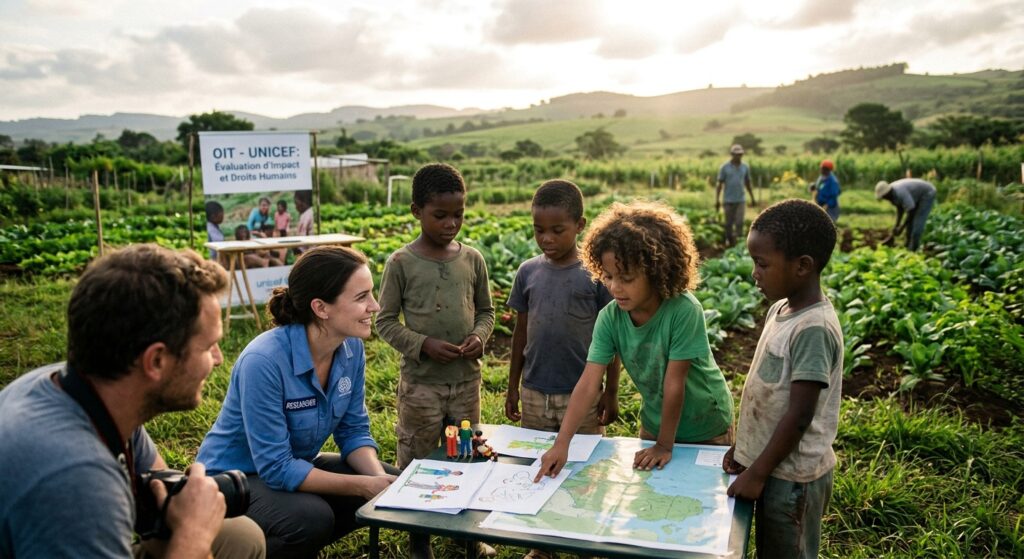
In a human rights impact assessment on an agricultural site, the question almost always comes up: should the children present on the farm be interviewed, or can the team do without it? The temptation is to move fast and ask directly. That is precisely the instinct international protocols ask teams to slow down. Collecting testimony from children or other vulnerable groups (migrant workers, isolated communities, people with disabilities) is never a simple methodological adjustment. It is an act that engages the responsibility of the company, the consulting firm and the field teams, and that, handled poorly, can do more harm than good. This post offers a field-level reflection on engaging vulnerable populations in human rights due diligence and impact assessment missions, drawing on two frameworks that now structure good practice: the ILO’s Ethical Guidelines for Research on Child Labour (2023) and the UNICEF Procedure on Ethical Standards in Research, Evaluation, Data Collection and Analysis (2021).
1. Why directly engaging children changes everything
The first question is not “how do we interview children?” but “is interviewing them directly even necessary?” The ILO guidelines include a decision tree designed for exactly that purpose: before any data collection involving children, the research team must assess whether the information could be obtained another way: analyzing existing survey data, reviewing service or case records, or interviewing service providers and caregiving adults instead. Only when these alternatives prove insufficient does a direct interview come into play, and even then a risk-benefit assessment must come first, with the explicit option of abandoning the research altogether if the risk to the child or to the interviewer is judged too high.
This “do no harm” principle is not a stylistic clause. In supply chains where child labor remains a documented reality (e.g.: cocoa in Côte d’Ivoire and Ghana, rubber, mica, parts of the textile sector) Ksapa’s practical guide on eliminating child labor notes that the underlying drivers are rarely uniform: households headed by single mothers, migrant workers facing language barriers, rural communities cut off from public policy. Asking a child about these realities without care means asking them to put words to something often shameful or dangerous for their family, with a real risk of retaliation or stigma once the field team has left.
It is also a question of data quality. A blunt question like “did you work?” frequently produces denial or a rehearsed answer, especially once the child understands that the answer implicates their parents. The reliability of the information therefore depends directly on the care taken with method, which leads to the second point: what the protocols actually require once the decision to engage children has been made.
2. What the protocols actually require
Once direct collection has been deemed necessary, both frameworks converge on a core set of operational requirements.
Consent is never binary. The UNICEF procedure distinguishes the child’s assent (their own willingness to participate, expressed in age-appropriate terms) from informed consent, which must be obtained separately from a parent or responsible adult. Assent alone is never sufficient. Both must be secured, and consent remains renegotiable: the child can withdraw from the research at any time, without needing to justify it.
Direct questioning is not always the right entry point. When children cannot be removed from the risky situation itself, the ILO guidelines recommend indirect questioning. Asking about knowledge, attitudes and perceptions rather than lived experience. Or the use of vignettes, stories built around fictional characters, to approach a sensitive topic without asking the child to expose themselves personally.
Recruiting and training field teams is a line of defense in its own right. Enumerators should be screened for their fitness to work with vulnerable populations and trained in child safeguarding practices. This point is often underestimated in terms of reference: where an interpreter is involved, they too must be trained on the project’s objectives, on child safeguarding principles and on age-appropriate language. An unprepared interpreter can turn a neutral question into an intrusive one through a careless rephrasing.
Confidentiality goes beyond simply withholding a name. The UNICEF procedure extends the notion of confidentiality to “demographically identifiable information”: in a small farming community, cross-referencing age, gender, ethnicity and hamlet of residence can be enough to identify someone even without naming them. This is a directly operational point for assessments conducted in low-density rural areas, where standard anonymization is not enough.
Referral pathways must exist before the fieldwork, not after. Teams must know their legal obligations to report abuse to the authorities and have a realistic referral mechanism in place for the local context. If a child discloses harm during an interview, the priority is to obtain the child’s informed consent to pass the information on to a relevant professional; if the child declines, the interviewer consults a designated focal point to decide on the course of action that best serves the child’s interests.
These requirements are not confined to the academic research field. The Children’s Rights and Business Principles, jointly developed by UNICEF, the UN Global Compact and Save the Children, explicitly tie these obligations to a company’s responsibility to respect human rights as defined by the UN Guiding Principles on Business and Human Rights. In other words: a consulting firm conducting an impact assessment for a commodity buyer operates under the same normative framework as an academic research agency, with the same duties of care.
3. What the field teaches that the protocols don’t always say
The guidelines set the framework, but field experience surfaces three lessons that condition how well it actually gets applied.
Trust is built before the interview, not during it. Field experience cited in the ILO guidelines shows that enumerators living in the community, who take time to play with children before asking any questions, achieve far higher acceptance rates from families than teams that arrive, interview and leave. Reassuring parents about confidentiality often matters more than reassuring the child directly, particularly in contexts where cultural norms tightly govern who is allowed to address a minor directly. Ksapa reaches a similar conclusion in its 5 keys to local human rights stakeholder engagement: the quality of a relationship with a community is built over time, and it directly determines whether a team earns the “social license” to carry out the survey at all, long before the first question is asked.
Sequencing engagement is not optional. Ksapa’s analysis of why due diligence demands real dialogue points out that the planning, implementation and monitoring phases call for different forms of engagement: identifying stakeholders and risks upfront, co-designing mitigation measures during implementation, then involving affected populations in assessing whether corrective measures actually worked. Treating children’s engagement as an isolated data-collection step, disconnected from this cycle, recreates exactly the risk the protocols are meant to avoid: asking sensitive questions without having the means, afterward, to respond to what was disclosed. IFC’s stakeholder engagement guidance makes the same point for community development projects: ongoing engagement is structurally cheaper than reactively managing a crisis born of poorly prepared engagement.
Technology helps, but it doesn’t replace human mediation. Digital tools (e.g.: short smartphone surveys, anonymized reporting platforms like what can be provided using Sutti Digital Platform) make it possible to collect data at greater scale and give populations a channel to flag a concern themselves, as Ksapa details in its analysis of technology to scale corporate impact on child labor. But these tools remove neither the need for explicit, child-comprehensible consent nor the need for a team trained to respond to an unexpected disclosure. Technology extends the reach of engagement; it never substitutes for the ethical vigilance that must frame it.
A practical takeaway
For a team preparing a mission involving children or other vulnerable groups, three reflexes summarize the essence of these field lessons: first ask whether direct collection is genuinely necessary; document, before going to the field, the consent process, interpreter training and referral pathways; and treat engagement as a continuous process rather than an isolated data-collection step. These are methodological requirements, but they are also, very concretely, what separates a credible impact assessment from a compliance exercise that collapses the moment it meets the field.

CEO and Co-Founder of Ksapa. Member of sustainability boards at major industrial groups and impact investment committees. Drawing on 25 years of experience working with multinationals, mid-size and small businesses across value chains, governments, and international organizations, Farid Baddache focuses on integrating human rights, climate, and ESG governance as drivers of business resilience and competitiveness. Author of several books on sustainability and responsible business. Connect on Bluesky @faridbaddache.bsky.social