
For two decades, the dominant logic of global supply chains was seductively simple: source at the lowest cost, consolidate volumes, optimize logistics. Geography was an operational variable. Geopolitics was someone else’s problem. The system hummed along, and few were incentivized to question it.
The Rules of Global Trade Have Changed — Permanently
That logic is now obsolete — and the breaking point was not a single event but a decade of accumulated shocks that exposed the same structural flaw, again and again. The Covid-19 pandemic brought entire production lines to a standstill, revealing catastrophic dependencies on a handful of manufacturing hubs for products as varied as semiconductors, active pharmaceutical ingredients, and industrial components. Russia’s invasion of Ukraine reconfigured energy, grain, and metals markets in weeks, blindsiding economies that had convinced themselves long-term contracts were a substitute for actual supply security. Climate disruptions — droughts in the Andes collapsing lithium brine production, flooding in Southeast Asia disrupting natural rubber and rice, social unrest in mining regions from the DRC to Guinea to Indonesia — have kept arriving with relentless regularity.
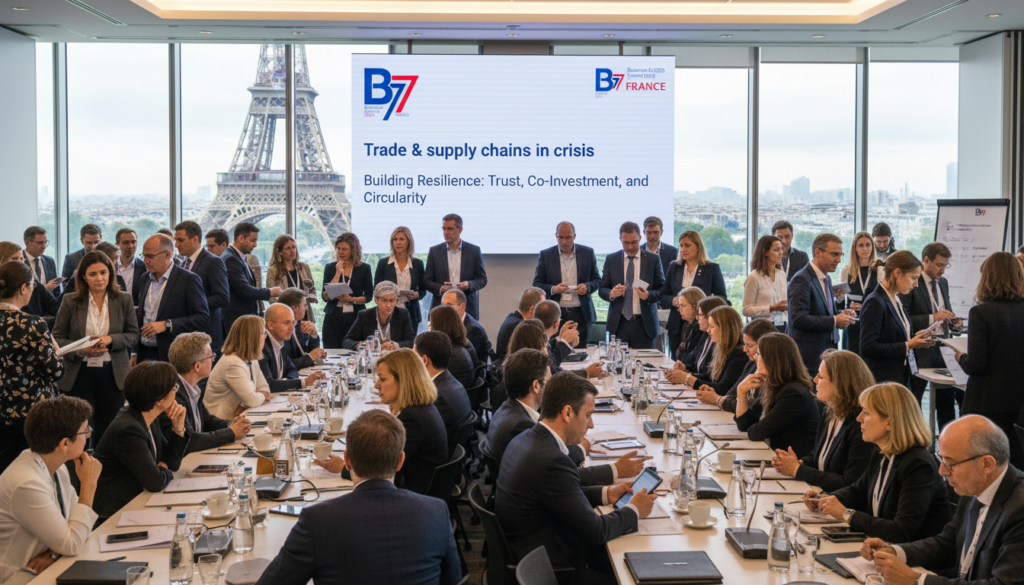
On May 5, 2026, the B7 — the coalition of the most representative business organizations from G7 nations — convened in Paris for a strategic conference on international trade and critical supply chain security. Around the table: leaders from MEDEF, the US Chamber of Commerce, BusinessEurope, Keidanren, Confindustria, and the UK’s CBI, alongside the EU’s DG Trade, the OECD, France’s Treasury, the Jacques Delors Institute, and executives from Northern Graphite, Aurubis AG, and Eramet. The configuration itself carried a message: supply chains are no longer a back-office concern. They are a board-level imperative.
A Decade of Warning Signs Business Chose to Ignore
The risks now rattling global supply chains are not surprises. They have been documented, modeled, and flagged in corporate risk registers and government intelligence reports for at least a decade. The real question is not why we didn’t see them coming. It is why, knowing what we knew, we chose to keep optimizing for cost over resilience.
The honest answer points to a cognitive blind spot that runs deep in corporate culture: the systematic underpricing of supply chain vulnerability. As long as cheap materials kept flowing, the short-term cost of diversifying sources, investing in traceability, and building supplier relationships beyond Tier 1 seemed unjustifiable. Risk committees nodded at the threat. Procurement teams bought at the market rate. And boards neither asked the right questions nor demanded the right answers.
Covid punctured that complacency with decisive force. Companies that had not mapped their upstream dependencies — who had no visibility beyond their direct suppliers — found themselves unable to respond when production halted. Not because they lacked the financial resources, but because they lacked the basic information. They did not know where their critical materials actually came from. They had, in effect, outsourced their strategic awareness along with their production.
This is the core insight that the B7 conference put on the table plainly: risk mapping and traceability are not compliance costs. They are investments in operational resilience. A company that pays a modest premium for materials whose provenance, sustainability, and supply chain integrity can be verified is making a fundamentally better risk-adjusted decision than one that buys at the lowest market price from an opaque source that could vanish overnight. The pandemic established the precedent. Russia-Ukraine reinforced it. The next disruption will not wait for companies still in denial.
The critical materials at the heart of these discussions span two distinct but equally vulnerable categories. The first is strategic minerals essential to the energy transition and digital economy: lithium, cobalt, rare earths, natural graphite, copper, manganese, nickel. These are geographically concentrated — often in politically fragile jurisdictions — and their supply chains are long, opaque, and poorly mapped by the companies that depend on them most. The second category is agricultural raw materials on which entire industrial supply chains depend: natural rubber, cocoa, coffee, soy, cotton, palm oil. Droughts, floods, labor conflicts, and regulatory shifts can disrupt these flows with consequences that ripple through the consumer goods, automotive, and food industries simultaneously.
Both categories share a common vulnerability profile: concentrated geographies, fragile producers, and buyers who have historically priced resilience out of their procurement models. That model has reached its limits.
From Rules-Based Order to Wild West — and the Road Back
The second major fault line running through this conference is the erosion of the international trading rules that once provided the predictability businesses depend on. The diagnosis from the room was unsparing.
The WTO’s dispute settlement mechanism has been effectively paralyzed since the United States blocked the renewal of Appellate Body members — a blockage that predates any single administration and reflects a bipartisan American skepticism about multilateral constraints on trade policy. The Doha Development Agenda never reached a conclusion. And since the explosion of unilateral measures — US tariffs imposed by executive decree, the EU Carbon Border Adjustment Mechanism, extraterritorial supply chain regulations, export controls on semiconductors and advanced machinery — every major economy now seems engaged in rewriting trade rules to its own advantage, in real time, without coordination.
What business leaders from the US Chamber, Keidanren, BusinessEurope, and Confindustria articulated at the Paris roundtable was a single, urgent demand: predictability. Companies can adapt to strict rules, even costly ones, as long as those rules are stable and known in advance. What they cannot manage is radical unpredictability — tariffs announced overnight, agreements repudiated by political whim, regulatory regimes that change faster than supply chain reconfiguration timelines. Investment horizons for mining projects run to fifteen years. Tariff environments can shift in fifteen days. That asymmetry is not manageable.
The path back to stability does not run through a revived WTO, at least not in the near term. It runs through a rebuilt architecture of bilateral and regional agreements grounded in genuine mutual interest. The CPTPP — the Comprehensive and Progressive Agreement for Trans-Pacific Partnership, now encompassing eleven Pacific economies — demonstrates that an ambitious, rules-based framework can hold together even in a turbulent geopolitical environment. The EU-India trade agreement under negotiation, OECD frameworks on sustainable supply chains, and structured dialogues with G20 emerging economies offer comparable opportunities to reconstitute a web of shared rules where global multilateralism has stalled.
The EU-UK-G7 alignment also represents a non-trivial coordination base. Regulatory convergence across these blocs — on due diligence standards, traceability requirements, carbon pricing, and social compliance — can create a de facto reference market capable of gravitating partner countries toward a shared standard. The UK’s Secretary of State for Business and Trade, present at this conference, was explicit: the UK’s post-Brexit trade posture is not isolation but he believes can be a strategic bridge-building — between the EU regulatory bloc and other strategic partners, including Commonwealth economies, Southeast Asian nations, and the Gulf.
The symmetric risk, flagged by multiple speakers, is progressive geo-economic fragmentation: the emergence of rival trade blocs whose decoupling reduces global flows, inflates the cost of critical materials, and slows access to the technologies the energy transition requires. That fragmentation would hit producing countries in the Global South hardest — undermining the very development partnerships that import-dependent economies need to build.
Which is precisely why geographic diversification — not decoupling, but genuine diversification of supply sources — is a strategic imperative, not a political statement. China remains a significant partner across multiple critical material supply chains, and pretending otherwise serves no one. But exclusive dependence on any single geography for strategic inputs is, by definition, a vulnerability. The G7 2026 process has formalized this insight by specifically engaging five partner countries: Brazil, a G20 anchor and a powerhouse in agriculture and mining; India, with its pivotal role in pharmaceutical, textile, and technology supply chains; Australia, a top-tier producer of lithium, cobalt, and rare earths; South Korea, an advanced industrial partner in batteries and semiconductors; and Kenya, playing a coordinating bridgehead role for Africa in alignment with the Africa Forward Summit of May 2026. This list should grow: Indonesia, the world’s largest nickel producer and a major agricultural supplier; Latin America broadly — Chile, Peru, and Colombia for minerals, Argentina and Brazil for agricultural commodities; and Central Asia, long underestimated, whose critical mineral reserves and geographic position make it a strategic partner of increasing relevance in any serious diversification scenario.
Building Resilience: Trust, Co-Investment, and Circularity
Against these two diagnoses — structural supply vulnerability and the erosion of trade rules — what does a credible architecture of solutions look like? Three lines of response emerged from the Paris conference, and they form a coherent logic when taken together.
The first is the construction of trusted trade agreements. The “trusted trade” framing that B7 representatives advanced is not rhetorical. It reflects an operational conviction: in a world where universal rules are weakened, the quality of the bilateral relationship between importing economies and producing countries becomes the primary supply security asset. These agreements go well beyond preferential tariffs. They encompass investment guarantees, dispute resolution mechanisms, commitments on social and environmental standards, and price and volume predictability clauses. The EU-Namibia strategic partnership on critical raw materials and the US Critical Minerals Agreements with several African and Latin American countries are early prototypes of this architecture. They are not perfect, but they establish the logic.
The second is productive co-investment between importing economies and producing countries. This is the most structurally important response, and the most politically demanding. For too long, the relationship between industrialized importers and raw material producers has been fundamentally asymmetric: buy cheap, extract maximum volume, create minimal local value. That extractive logic is collapsing — rejected by producing-country governments through resource nationalism, undermined by the regulatory expectations of the EUDR, CSRD, and CSDDD, and increasingly incompatible with the ESG expectations of institutional investors and end consumers alike.
The alternative model — equitable partnership between producers and importers — requires a genuine shift in how companies think about procurement. Investing in sustainable supply relationships, in local capacity building, in shared data infrastructure, and in fair value distribution is not philanthropy. It is advanced risk management. It builds the supply chain resilience that pure cost optimization never could. The companies that have understood this are building durable competitive advantages. Those still treating suppliers as interchangeable commodity vendors are accumulating fragility.
The third line of response is circularity as a strategic lever for supply sovereignty. Aurubis, one of Europe’s leading copper recyclers, exemplifies this logic clearly: recycling critical metals — copper, tin, zinc, precious metals — structurally reduces dependence on primary material flows whose geography is concentrated and whose supply risks are high. But the European circular economy faces a competitive distortion that must be addressed directly. High-value recyclable waste — copper scrap being the clearest example — is being massively exported to third countries, most notably China, at prices that often reflect non-internalized environmental and social costs. The result is paradoxical: Europe exports its copper scrap, imports primary copper, and leaves its domestic recycling capacity chronically under-supplied. Establishing European border duties on exports of high-value recyclable waste — a mechanism that would complement the Carbon Border Adjustment Mechanism targeting carbonintensive imports — would rebalance this market, secure the material base for European recyclers, and accelerate the circular economy transition that the Critical Raw Materials Act and Ecodesign Regulation are designed to drive. Circularity is a policy choice as much as a technical one.
Ksapa’s Role: From Risk Awareness to Strategic Action
Ksapa is not a bystander in these dynamics. Our core mission — accompanying companies and development finance institutions in the sustainable transformation of global value chains — places us directly at the intersection of every challenge this conference addressed.
The first thing we do with clients — industrial companies, consumer goods manufacturers, commodity traders, impact investors — is help them build a credible risk map of their supply chain. Not a compliance exercise. A strategic one. Until a company knows precisely where its critical dependencies lie — which Tier 2 or Tier 3 supplier, in which country, on which material — it cannot make informed procurement decisions, cannot have a meaningful conversation at board level, and cannot respond when disruption arrives. Risk mapping is the foundation of everything else.
The SUTTI platform, deployed across worker and smallholder populations in Southeast Asia and sub-Saharan Africa in supply chains ranging from natural rubber and cocoa to industrial waste and mining services, operationalizes that visibility at scale. It collects behavioral and operational data from producers and workers who are invisible to conventional audit systems — generating the real-time supply chain intelligence that companies need both for regulatory compliance (EUDR, CSRD, CSDDD) and for actual supply security. Traceability is not an administrative burden. It is the raw material of sovereign procurement strategy.
Our work in development finance focuses on structuring the blended finance mechanisms that make sustainable sourcing economically viable in high-risk geographies. We operate across the diversification map the G7 is drawing: Southeast Asia, sub-Saharan Africa, and Latin America are not just risk zones for global supply chains. They are also the regions where the most durable supply partnerships will be built — if the right investment models are deployed.
What the B7 conference of May 5 confirmed is that the companies best positioned for the decade ahead are those that have already started: mapping their risks, investing in traceability, diversifying their supplier base, building equitable producer partnerships, and integrating circularity into their industrial model. The others — those waiting for the next disruption to force their hand — are accumulating strategic debt that will be costly to repay.
The window to act proactively is narrowing. The time to act is now.

CEO and Co-Founder of Ksapa. Member of sustainability boards at major industrial groups and impact investment committees. Drawing on 25 years of experience working with multinationals, mid-size and small businesses across value chains, governments, and international organizations, Farid Baddache focuses on integrating human rights, climate, and ESG governance as drivers of business resilience and competitiveness. Author of several books on sustainability and responsible business. Connect on Bluesky @faridbaddache.bsky.social