
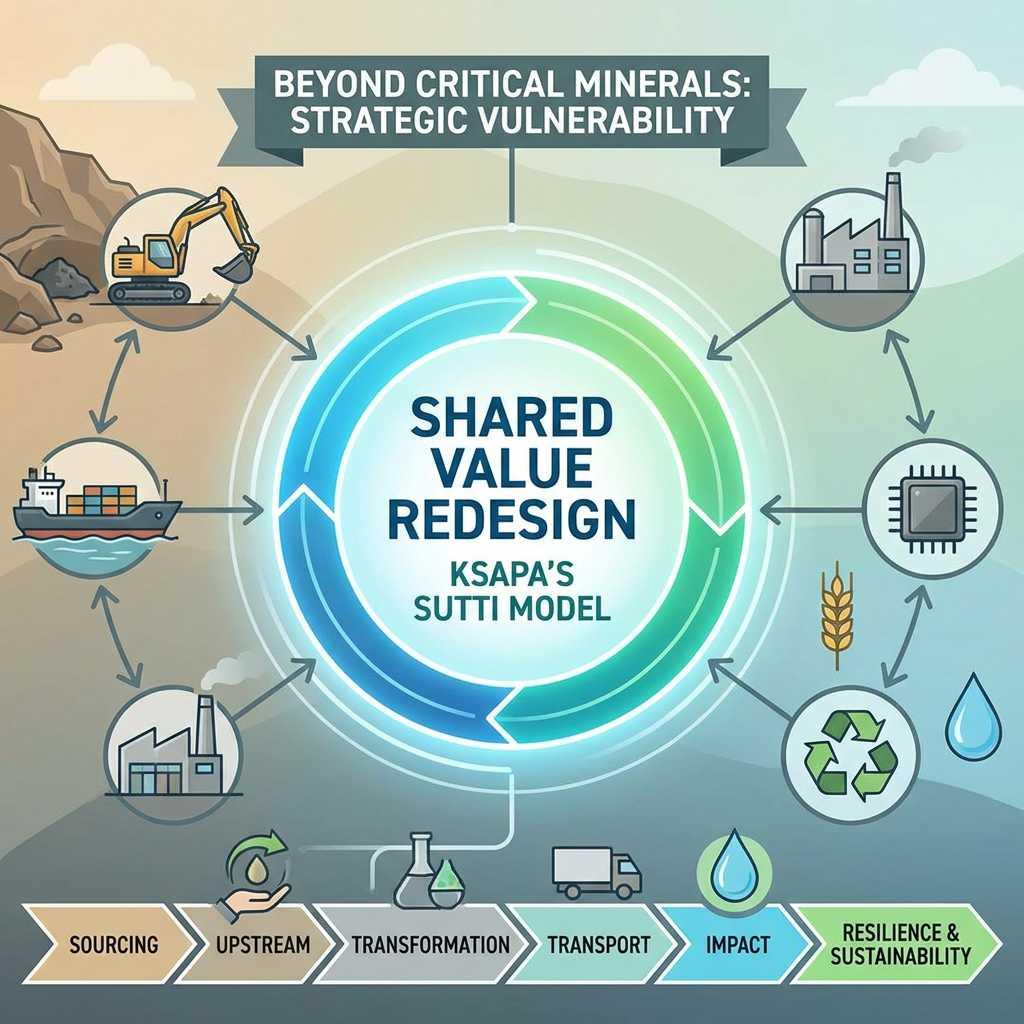
The geopolitics of critical minerals has never moved faster. In the span of a few months, the G7 adopted a Critical Minerals Action Plan under Canada’s presidency, the EU and United States signed a coordinating memorandum of understanding, and Brussels began weighing legislation that would require companies in sensitive sectors to source from at least three distinct suppliers rather than rely on a single dominant country. The urgency is real: China currently supplies roughly 98% of the EU’s rare earth inputs, and Beijing’s export controls — tightened in response to US tariff escalation — have already forced some European manufacturers to halt production lines. Yet beneath the flurry of announcements, a structurally important question remains underexplored: in the rush to diversify and secure supply, are G7 economies building systems that create shared value with producing countries, or simply reproducing old patterns of extractive dependency under a new geopolitical banner? At Ksapa, we believe the answer depends entirely on the governance and measurement infrastructure that underpins these new supply chains. That is precisely where the SUTTI platform, and the broader model of stakeholder-centered due diligence, has a distinctive and timely role to play.
The Architecture of a New Race and Its Blind Spots
The G7’s October 2025 Roadmap to Promote Standards-Based Markets for Critical Minerals is, in many respects, an ambitious document. It commits members to traceability and transparency systems, to interoperable digital credentials aligned with the UN Transparency Protocol, and to performance-based criteria covering labor and human rights standards, rule-of-law benchmarks, and environmental protections. The language of free, prior, and informed consent for Indigenous communities appears explicitly. On paper, this is a serious attempt to move beyond extraction as usual.
The T7 Think Tank Taskforce’s March 2026 Solutions Paper, produced for the French G7 Presidency, goes further. It argues that supply chain resilience ultimately requires enabling mineral-rich countries to participate in midstream and downstream processing — not just extraction. It calls for a political compact in which G7 importing countries explicitly commit to supporting downstream value creation in producing countries, “recognizing that this may entail higher short-term costs, adjustments to domestic industrial strategies, and complex supply-chain governance.” It proposes lighthouse investment pilots with coordinated Development Finance Institution platforms, blended finance vehicles, and social dividends priced into return-on-investment calculations from the outset.
Simultaneously, the EU’s proposed Economic Security legislation would mandate supply chain diversification across high-risk sectors — chemicals, industrial machinery, automotive supply chains — on top of critical minerals. Diversification now requires a dedicated instrument. This legislation understands the urgency for critical minerals, but also acknowledges that every high-risk sector must be weaned off single supplier dependence.
The direction of travel is clear. The blind spot is equally clear: ambitions around traceability, ESG standards, and inclusive value creation are only as good as the on-the-ground systems capable of collecting, verifying, and surfacing the relevant data. Policy commitments and framework documents do not automatically generate the worker-level, community-level, and smallholder-level intelligence that makes a supply chain genuinely transparent and equitable. That gap is where Ksapa works every day.
Critical Minerals Are the Headline. They Are Not the Whole Story.
Here is the problem with the current policy conversation: it is almost entirely organized around a specific list of materials — lithium, cobalt, rare earths, graphite, nickel — whose strategic importance has been made visible by the energy transition and geopolitical rivalry with China. That visibility is real and the urgency legitimate. But the analytical framework it has generated is dangerously narrow.
Supply chain vulnerability is not a property of a specific list of minerals. It is a structural condition that emerges wherever three variables converge: geographic concentration of production, weak governance at the point of extraction or processing, and asymmetric dependence between buyers and producing communities. Those three variables can be found in cobalt mining in the DRC. They can equally be found in cocoa farming in West Africa, natural rubber smallholding in Indonesia and Côte d’Ivoire, cotton cultivation in Central Asia, seafood processing in Southeast Asia, or soy production in Latin America. The supply chain shocks that disrupted food systems during the COVID-19 pandemic, the labor rights crises that emerged in palm oil and garment supply chains, the deforestation controversies that have repeatedly destabilized agricultural commodity markets — these were not aberrations. They were expressions of the same structural vulnerability that the critical minerals conversation is now attempting to address, but in sectors that have not yet been granted the same policy urgency.
The EU’s own Corporate Sustainability Due Diligence Directive (CSDDD) implicitly recognizes this. Its obligations on human rights and environmental due diligence apply across supply chains regardless of the commodity involved. The EUDR’s deforestation requirements cover cocoa, soy, palm oil, cattle, wood, coffee, and rubber alongside minerals. The G7’s labor and human rights criteria in their critical minerals standards — compliance with ILO fundamental principles, meaningful community engagement, safe and ethical workplaces — are not principles that apply only underground. They apply in fields, fisheries, and factories with equal force.
What the critical minerals conversation has generated, usefully, is a political and regulatory architecture for operationalizing these principles at scale. The task now is to extend that architecture to the full range of commodities and components where strategic vulnerability, governance gaps, and equity deficits intersect. For companies navigating this landscape, the starting point is not a policy document — it is a rigorous supply chain risk mapping exercise.
Start Where It Matters: Supply Chain Risk Mapping as the Foundation
Before any company can determine what governance infrastructure it needs, what traceability tools to deploy, or what shared value architecture to build, it needs to know where its vulnerabilities actually lie. That requires a systematic supply chain risk mapping: a structured assessment of which inputs, components, and raw materials across its full value chain carry meaningful exposure on three dimensions simultaneously: strategic concentration risk (is this input sourced from one country, one region, or one supplier cluster?), regulatory and reputational risk (is it subject to due diligence legislation, deforestation rules, or sector-specific transparency requirements?), and social and environmental risk (are the workers, communities, and ecosystems involved in its production exposed to meaningful harm?).
This is not a compliance exercise dressed up in new language. Done properly, it is a strategic intelligence function that reframes how companies understand their cost structures, their supplier relationships, and their long-term license to operate. A tire manufacturer that has only mapped its battery-metal exposure but not its natural rubber sourcing has mapped half its strategic vulnerability. A food and beverage company that has addressed deforestation in palm oil but not labor rights in cocoa or water risk in coffee has a partial picture at best. A semiconductor company focused on rare earth inputs from China without considering the governance conditions in the countries it wants to diversify toward is planning a substitution, not a solution.
Ksapa has developed a supply chain risk mapping methodology that integrates these three dimensions — concentration, regulatory, and social/environmental — into a unified heat map framework. It draws on external databases (OECD risk indices, standards, UNGP-aligned human rights risk geographies), on sectoral expertise from Ksapa’s work across agricultural commodities, natural resources, and manufacturing supply chains, and critically on primary data from SUTTI deployments that surface on-the-ground conditions that no external database captures. The output is not a static report. It is a prioritization framework that tells a company which of its supply chains are in scope for deeper intervention, in what sequence, and with what urgency.
This risk mapping is the mandatory starting point. Everything that follows — the traceability infrastructure, the shared value architecture, the blended finance structures, the SUTTI deployment — is downstream of knowing where the real exposure lies.
SUTTI as MRV Infrastructure Across the Full Range of Strategic Supply Chains
Once a company has mapped its risk landscape, the question becomes how to generate the continuous, credible, stakeholder-level data that governance frameworks — regulatory and voluntary alike — increasingly require. This is where SUTTI’s architecture becomes directly relevant, and where its track record across agricultural supply chains carries particular weight.
SUTTI operates through mobile-first interfaces accessible to workers, smallholder farmers, and community members in low-connectivity environments. It enables real-time collection of data on working conditions, environmental practices, grievance mechanisms, land-use consent processes, and livelihood indicators. In contexts where third-party audits produce point-in-time snapshots that are easily gamed, SUTTI generates continuous, participatory signals from the people whose livelihoods are most directly shaped by supply chain decisions.
In natural rubber — where Michelin and major tire producers face cascading EUDR compliance requirements and human rights due diligence obligations — SUTTI has been deployed to map smallholder farmer conditions, verify environmental practices, and structure grievance channels across multi-tier supply chains in Southeast Asia and West Africa, including through the CASCADE program. In cocoa and palm oil, SUTTI supports similar functions, with the IREN AGRI blended finance vehicle integrating SUTTI data flows as part of its impact measurement and reporting framework co-developed with Société Générale. In each case, the governance challenges — multi-tier supply chains, informal labor, smallholder dominance, weak sub-national state capacity — closely mirror what any sector faces when it tries to move beyond compliance toward genuine accountability.
SUTTI’s value operates on three consistent levels regardless of the commodity or component involved. As measurement, reporting, and verification (MRV) infrastructure, it generates the continuous, credible, worker-level data that standards frameworks require but rarely specify how to produce. As a consent and grievance architecture, it operationalizes free, prior, and informed consent and worker voice commitments that remain largely aspirational in most supply chain governance frameworks. And as a data asset for finance structuring, it generates the impact intelligence that development finance institutions and blended finance vehicles need to price social dividends into investment calculations — a condition the T7 Taskforce explicitly identifies as central to making responsible lighthouse pilots work.
The critical insight is that this architecture is commodity-agnostic. The same platform and methodology that verifies labor conditions in a rubber smallholding in Sumatra can document community consent processes in a lithium extraction zone in the DRC, track migrant worker conditions in a seafood processing facility in Thailand, or measure living income progress for cocoa farmers in Côte d’Ivoire. What varies is the sectoral context and the specific indicators that matter. What does not vary is the underlying logic: that supply chain accountability requires continuous, participatory, field-level data — not periodic audits conducted by external verifiers who spend two days at a site.
Designing for Shared Value, Not Just Supply Security
There is a version of the critical minerals transition — and more broadly, a version of supply chain resilience policy — that looks like a successful geopolitical rebalancing for G7 economies and a replication of extractive relationships for producing countries. History is full of such transitions. The colonial rubber trade, the mid-twentieth century cobalt economy in the Congo, the rare earth processing arrangements that China structured over decades, the structural adjustment programs that locked agricultural commodity exporters into low-value raw material roles — all involved producing countries bearing the environmental, social, and health costs while consuming countries captured the downstream value.
The T7 Taskforce is explicit that the G7 must consciously resist this pattern for critical minerals. The same logic applies with equal force to agricultural commodities and any other strategic input. Shared value — in the sense Michael Porter and Mark Kramer articulated, and that Ksapa has applied across over a decade of consulting and impact investing — is not philanthropy added on top of a supply chain. It is the architecture of a supply chain redesigned so that the incentives of producers, communities, and consumers align rather than conflict.
Concretely, this means structuring offtake and financing arrangements so that value captured at processing and manufacturing stages flows back to producing communities. It means deploying platforms like SUTTI not as compliance tools imposed from above but as empowerment infrastructure that gives workers and smallholders the data and voice to negotiate their terms of participation. It means designing blended finance vehicles — the kind Ksapa has developed through IREN AGRI and continues to develop for natural rubber and other commodity sectors — so that concessional capital is explicitly conditioned on community benefit metrics, not merely on ESG box-ticking.
And it means building traceability infrastructure that serves producing-country institutions as well as importing-country regulatory requirements. Traceability that only generates data useful to European compliance officers is not shared infrastructure — it is a new form of informational asymmetry embedded in the supply chain. Traceability that surfaces data useful to farming cooperatives, to community land-use bodies, to local government development planners — that is the architecture of a more equitable trade system.
A Moment That Demands Concrete Models Across Every Strategic Supply Chain
The policy window is open. The G7’s Critical Minerals Action Plan, the EU’s forthcoming Economic Security legislation, the CSDDD, the EUDR, the US-EU partnership framework, and the French G7 Presidency’s T7 agenda all point in the same direction: the governance of global supply chains is being redesigned in real time, and the design choices made in the next two to three years will shape the structure of these value chains for decades.
Ksapa’s position is that this redesign will succeed — for G7 economies and for producing countries alike — only if it is built on concrete, field-tested models of stakeholder engagement, participatory data collection, and shared value architecture. Critical minerals are the current political focal point, and rightly so. But the analytical framework and operational infrastructure required to govern them equitably is the same framework and infrastructure required for cocoa, rubber, cotton, seafood, and any other commodity where concentration, governance gaps, and equity deficits intersect.
The place to start is always a rigorous supply chain risk mapping. From there, the path runs through continuous field-level data, through consent and grievance architectures that give producing communities real voice, and through financing structures that price shared value into the investment from the outset — not as a reporting afterthought.
If you are working on these questions — whether from a corporate supply chain, investor, policy, or civil society vantage point — we want to build with you. The race to secure supply chains is already underway. The race to make that security genuinely equitable, across every strategic commodity, is just beginning. That is the race Ksapa is running.

CEO and Co-Founder of Ksapa. Member of sustainability boards at major industrial groups and impact investment committees. Drawing on 25 years of experience working with multinationals, mid-size and small businesses across value chains, governments, and international organizations, Farid Baddache focuses on integrating human rights, climate, and ESG governance as drivers of business resilience and competitiveness. Author of several books on sustainability and responsible business. Connect on Bluesky @faridbaddache.bsky.social