
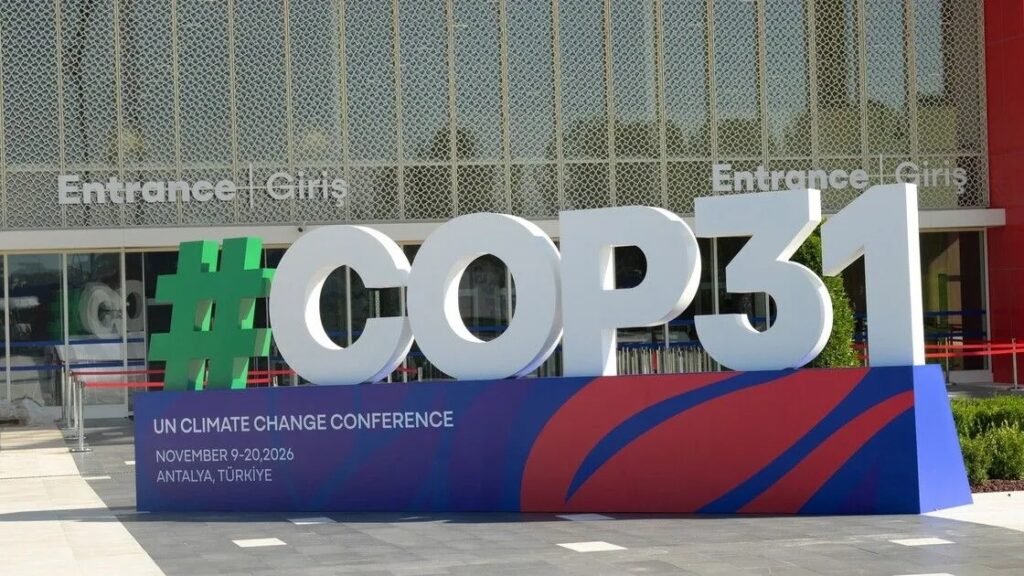
That COP31 ended without a political deal is old news, even though it is the first such failure since Copenhagen in 2009. For companies and investors, the real question lies elsewhere: what can a strategy be built on when political leadership is missing and climate impacts are accelerating? Beneath the noise of the plenaries, Carbon Brief’s detailed review reveals technical decisions, timelines and market signals that do carry weight. Three certainties emerge: the measurement framework is tightening, public money will not follow, and value chain due diligence will be decided outside the COPs. Each one calls for decisions from 2027 onward.
Certainty one: the measurement framework is tightening, deal or no deal
The instruments that measure climate action keep moving forward, whatever happens to the political declarations. The second global stocktake of the Paris Agreement was launched in Antalya and will run until 2028. As the Agreement provides, it will inform the next generation of nationally determined contributions, and with them the sector policies that governments adopt worldwide. The mitigation work program has been extended to 2030.
Adaptation is becoming measurable. The 59 indicators for the global goal on adaptation agreed in Belém remain on the table. A technical task force, made up of six experts per UN regional group plus three nominated by the least developed countries and three by small island developing states, will test them. What gets measured ends up being compared, then required: exposed companies should expect to report on their resilience with the same rigor as on their emissions.
Carbon markets are entering a scrutiny phase. Technical reviews under Article 6.2 identified 543 inconsistencies across 16 reports, 115 of them classed as significant. The final decision merely “takes note” of them, and funding for Article 6.2 infrastructure remains unresolved. Article 6 rules will be reviewed from 2028. For buyers and developers of credits, the conclusion is straightforward: integrity will face growing scrutiny, and due diligence on credit quality is now a risk management issue.
Furthermore, international law is moving faster than the negotiations. In July 2025, the International Court of Justice delivered a unanimous advisory opinion, requested by Vanuatu and other Pacific island nations, describing climate change as an “urgent and existential threat.” The Court anchored states’ obligations in the Paris Agreement’s 1.5°C goal and found that failing to protect the climate system, including through fossil fuel production, consumption or subsidies, may constitute an internationally wrongful act. The opinion is not directly enforceable, but it strengthens the basis for climate litigation worldwide, alongside rulings from the Inter-American Court of Human Rights and the European Court of Human Rights. For companies and investors, the consequences are concrete: more lawsuits targeting new oil and gas projects, more pressure for stronger emission reduction targets, and increasingly complex compliance requirements. As we noted at the time, climate action is now a legal obligation under international law, and aligning value chains with these emerging legal frameworks has become a matter of risk management, not just ambition. Companies already have the tools to act ahead of the negotiators.
Certainty two: adaptation will be financed without the public money expected
The decline in public finance is now documented. According to a Carbon Brief analysis, public climate finance pledges to developing countries have fallen by more than 70%, as most pledges expired in 2025 and few donors replaced them. The collective goal of $300 billion a year by 2035, set in Baku, remains unchanged, and no new money was agreed in Antalya.
On adaptation, the ambition to “triple” finance by 2035 is restated, but no final text sets an amount or a baseline year. According to Climate Action Network, as reported by Carbon Brief, a 2025 baseline would mean $120 billion a year by 2035, while a 2019 baseline would mean $60 billion. An Antalya–Addis Ababa roadmap on adaptation finance has been launched, with conclusions due at COP32. The loss and damage fund remains far short of needs, with $342 million pledged against $2.8 billion in funding requests.
One concrete mechanism deserves attention: the Adaptation Fund will be able to receive 5% of the proceeds from the Article 6.4 mechanism. Carbon markets thus become a structural source of adaptation finance. It is one more sign that money for resilience will flow through market mechanisms and private actors far more than through public budgets.
For companies, the physical trajectory leaves no choice. As we argued after COP30, businesses must now lead the transformation of their own value chains, including by investing in the adaptation of the most exposed producers and suppliers. Blended finance is one of the few levers able to do this at scale: structures combining public, philanthropic and private capital, with guarantees, concessional tranches and long-term offtake contracts. There is no green without just, and the financial architecture often decides whether a transition is fair. Investors have their part to play too, by factoring human rights into investment decisions from the outset.
Certainty three: value chain due diligence will be decided outside the COPs
The just transition mechanism has not been abandoned, but it will not be operational before 2027 at best. Created in Belém, the Belém-Antalya mechanism is meant to turn years of dialogue into concrete support for workers and communities. The decision adopted in Antalya sends its design to Bonn in June 2027 and its formal adoption to COP32. A two-tier structure, with a governance body and an operational arm, enjoys broad support.
The most concrete signal concerns critical minerals. The OECD sets out the due diligence essentials for responsible minerals. The Business & Human Rights Resource Centre tracks abuses linked to transition minerals, notably in the DRC. Chatham House argues that secure supply chains increasingly depend on responsible production, and Amnesty International explains why critical minerals matter for human rights.
Major economies are holding their line. The European Union refused to endorse a text that was silent on fossil fuels. On fossil fuels, coalitions of countries are now moving outside the negotiations, building on the voluntary roadmap published by the Brazilian COP30 presidency. For companies, standards will therefore come from the UN Guiding Principles and the OECD Guidelines, from European due diligence rules, even recalibrated, from national laws such as those in Germany and Norway, and from investors and buyers worldwide. Effective due diligence depends on the role of stakeholders, which is why due diligence demands real dialogue with affected communities. The just transition is also steered at governance level, and boards play a critical role in making it happen.
In light of what COP31 has confirmed, four decisions can be taken now:
- Map the physical exposure of critical suppliers, drawing on the adaptation indicators currently being defined.
- Embed human rights due diligence in mining and agricultural supply chains, without waiting for a UN framework.
- Structure blended finance vehicles to fund the adaptation of the most exposed suppliers.
- Contribute to the design of the just transition mechanism ahead of the Bonn session in June 2027, bringing field experience from value chains.
Antalya does not change the direction of travel, but it shifts responsibility onto economic actors. Ksapa has worked with 100+ clients since 2019, with experts active for 25+ years, helping companies and investors transform their value chains without waiting for COP32.
Image by Magnific – Free License

CEO and Co-Founder of Ksapa. Member of sustainability boards at major industrial groups and impact investment committees. Drawing on 25 years of experience working with multinationals, mid-size and small businesses across value chains, governments, and international organizations, Farid Baddache focuses on integrating human rights, climate, and ESG governance as drivers of business resilience and competitiveness. Author of several books on sustainability and responsible business. Connect on Bluesky @faridbaddache.bsky.social