
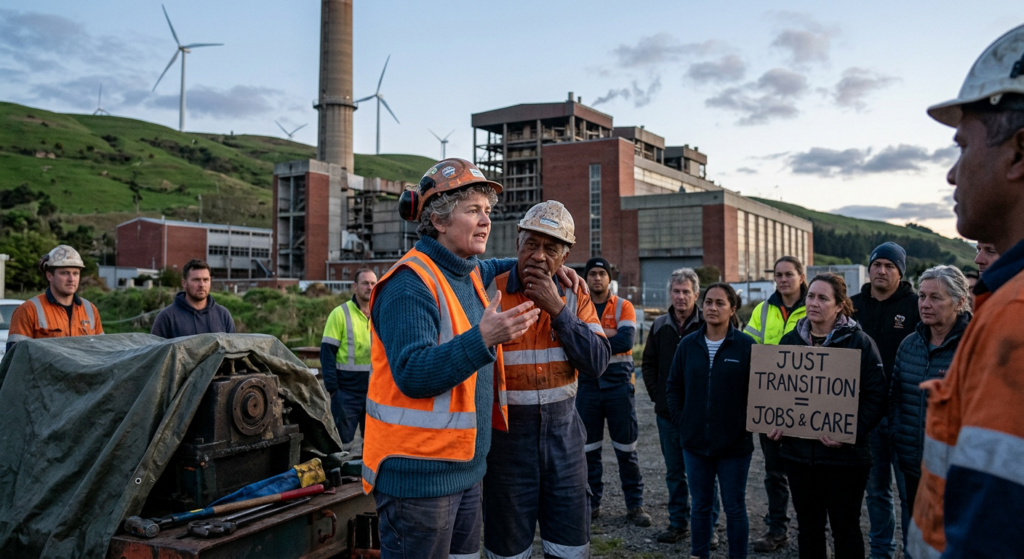
The global shift away from fossil fuels is happening faster than most companies anticipated. Solar and wind capacity additions are breaking records. Automakers are racing to electrify. Entire industrial ecosystems — steel, cement, chemicals — are under mounting pressure to decarbonize. Yet in the rush to hit net-zero milestones, a quieter crisis is unfolding: the workers, communities, and smallholder farmers embedded in transitioning sectors are being left to absorb costs they did not create. The OECD’s May 2026 report, Responsible Business Conduct for a Just Transition: Protecting Workers, Communities and Consumers in the Low-Carbon Transition, puts this contradiction front and center. The report is unambiguous: the energy transition generates real opportunities for innovation, competitiveness, and decent work — but if the social dimension is mismanaged, it will ultimately undermine the pace of decarbonization itself. At Ksapa, this is a diagnosis we have arrived at through twenty-five years of fieldwork across supply chains in West Africa, Southeast Asia, and Latin America. The green transition is not automatically a just one. Making it so requires deliberate corporate conduct, rigorous due diligence, and credible measurement systems — not declarations of intent.
Why “Just” Is Not Optional
The OECD report grounds its recommendations in the existing architecture of responsible business conduct (RBC): the OECD Guidelines for Multinational Enterprises, the UN Guiding Principles on Business and Human Rights (UNGPs), and ILO labor standards. This is significant. It means that managing the social impacts of decarbonization is not a philanthropic add-on — it is an expression of baseline corporate due diligence obligations that already apply to companies operating across global value chains.
What the report adds is a sector-specific lens. The low-carbon transition creates three distinct categories of social risk that companies must actively address.
The first is workforce disruption. Coal miners in Appalachia or in South Africa’s Mpumalanga province, rubber tappers whose cooperatives may be restructured as demand patterns shift, or factory workers in automotive supply chains facing rapid retooling — all face transitions that are rarely smooth. The OECD report calls on companies to embed just transition planning into their climate strategies, including meaningful consultation with workers and their representatives, access to retraining, and transparent timelines.
The second is community-level impact. The energy transition is accelerating demand for critical minerals — lithium, cobalt, nickel — sourced predominantly from communities in the Global South that have historically borne the burden of extractive industries without sharing proportionally in the benefits. The report calls for enhanced community engagement, impact assessment, and grievance mechanisms that are accessible to affected populations.
The third is consumer fairness. As energy costs shift and green premiums become embedded in product pricing, the transition risks becoming regressive — placing disproportionate burdens on lower-income households and consumers in developing markets. Companies, the report argues, must factor affordability and non-discrimination into their transition plans.
The practical implication is clear: a company that achieves its Scope 1 and 2 targets while simultaneously stranding its workforce or destabilizing dependent communities has not completed its transition obligations. It has merely redistributed the harm.
Supply Chains as the Hidden Social Frontier
One of the most consequential — and underappreciated — dimensions of the just transition challenge lives not in a company’s direct operations, but deep in its supply chains. This is where Ksapa has concentrated much of its work over the past decade.
In the natural rubber sector, Ksapa has been supporting global tire manufacturers and commodities traders to implement responsible sourcing frameworks that go beyond deforestation commitments. Our work with major actors in the CASCADE initiative and with sourcing programs in Southeast Asia and West Africa consistently reveals the same structural gap: smallholder farmers and contract workers at the base of the supply chain are among the most economically vulnerable actors in the system — and they are the last to be consulted when transition decisions are made upstream.
When a tire company commits to sourcing deforestation-free rubber by 2030, the ripple effects reach into villages in Côte d’Ivoire and Thailand where farming families depend on decades-old cultivation practices. The transition asks those families to adopt new techniques, accept new certification requirements, and absorb the costs of compliance — often without access to the technical support or finance they need to do so. Done well, this creates shared value and durable supply chain resilience. Done poorly, it generates social stress that eventually surfaces as supply disruptions, reputational incidents, or legal exposure under the EU Deforestation Regulation or the Corporate Sustainability Due Diligence Directive (CSDDD).
This is why Ksapa developed the SUTTI platform — a digital tool designed to deliver structured engagement, training, and grievance mechanisms at scale to workers and smallholder farmers who are too often invisible to corporate due diligence systems. In rubber supply chains, in cocoa sourcing, and in apparel and textile manufacturing, SUTTI generates verified data on working conditions, income levels, and training uptake that companies can use to demonstrate meaningful social performance — not just aspirational commitment. It is, in essence, the measurement and verification infrastructure that the OECD report implicitly calls for when it asks companies to implement their RBC recommendations with operational rigor.
In the cocoa sector, Ksapa has been developing the IREN AGRI blended finance vehicle with partners including Société Générale, specifically to channel transition-enabling finance toward smallholder farmers. The logic is straightforward: if companies expect farmers to adopt climate-smart practices, they must also help de-risk the investment required to do so. Blended finance — structured to absorb first-loss risk through development finance institutions — can unlock commercial capital at a scale that grant funding alone cannot achieve. This is the financial architecture of a just transition made operational.
From Framework to Practice: What Companies Must Actually Do
The OECD report provides a framework. But frameworks only matter if they change behavior. Based on Ksapa’s experience supporting companies across sectors including mobility, luxury goods, agribusiness, and infrastructure, we see three operational imperatives that distinguish companies genuinely embedding just transition principles from those managing appearances.
The first is extending due diligence to social transition risks. Most corporate climate strategies focus overwhelmingly on environmental metrics — carbon intensity, renewable energy share, deforestation commitments. The OECD report rightly insists that social due diligence must be applied with the same rigor. This means mapping which worker populations and communities are exposed to transition risks in value chains, assessing the severity and likelihood of those impacts, and putting in place concrete mitigation measures. The regulatory momentum behind this expectation is now genuinely global: the EU’s Corporate Sustainability Due Diligence Directive (CSDDD), Germany’s Supply Chain Due Diligence Act (LkSG), Norway’s Transparency Act, the UK’s Modern Slavery Act, Australia’s equivalent legislation, Canada’s Bill S-211, and a growing body of US import enforcement under the Uyghur Forced Labor Prevention Act all signal that human rights and social due diligence are converging toward a baseline compliance expectation for multinationals — regardless of where they are headquartered. Ksapa’s consulting practice has been supporting companies navigating this multi-jurisdictional landscape for years, and the consistent finding is the same everywhere: the social dimension of transition risk is systematically underestimated in conventional ESG assessments.
The second is making stakeholder engagement real. The OECD guidelines call for meaningful consultation with affected stakeholders — but in practice, many companies conduct engagement that is largely informational and poorly timed. Genuine engagement happens before decisions are made, with actors who have real leverage to shape outcomes, and through channels that are accessible to low-literacy or low-connectivity populations. Ksapa’s agricultural commodity sourcing work illustrates what this looks like in practice: working backward from the farmer and the collector to understand what a responsible sourcing transition actually requires, rather than forward from a procurement policy looking for validation.
The third is connecting transition finance to verified social outcomes. As the blended finance architecture for just transition matures — with instruments like transition bonds, sustainability-linked loans, and outcome-based development finance. The question of what counts as social performance becomes critical. Ksapa’s work developing the SUTTI-based measurement and reporting framework for supply chain debt facilities addresses this directly: impact capital requires impact data, and impact data requires systems capable of generating it at the level of the worker and the farmer, not just at the level of the corporate report.
The Stakes Are High — and So Is the Opportunity
The OECD’s new report arrives at a moment when the political backlash against ESG frameworks is creating real uncertainty for corporate sustainability teams. In the United States, several major companies have walked back diversity and climate commitments under political pressure. In Europe, the CSDDD implementation timeline is under discussion and some provisions are being recalibrated. It would be tempting, in this environment, to treat the just transition as a discretionary investment — something to do when conditions are favorable.
That would be a strategic error. The social risks embedded in poorly managed transitions do not disappear because they are deprioritized — they accumulate. The communities, workers, and farmers who are not supported through a just transition do not simply accept their position quietly. They generate supply disruptions, regulatory responses, reputational crises, and, ultimately, social opposition to the very decarbonization agenda that companies are trying to advance. The OECD report is right that mismanaged social impacts can undermine the pace of the transition itself. This is not a moral argument, though the moral case is also compelling. It is a business continuity argument.
At Ksapa, we believe that the companies that will successfully navigate the decade ahead are those that treat RBC for just transition not as a compliance obligation, but as a competitive differentiator. A demonstration of the operational capability to manage complex, multi-stakeholder transitions at global scale. The tools exist. The frameworks exist. What is needed now is the will to use them with the seriousness the moment demands.

CEO and Co-Founder of Ksapa. Member of sustainability boards at major industrial groups and impact investment committees. Drawing on 25 years of experience working with multinationals, mid-size and small businesses across value chains, governments, and international organizations, Farid Baddache focuses on integrating human rights, climate, and ESG governance as drivers of business resilience and competitiveness. Author of several books on sustainability and responsible business. Connect on Bluesky @faridbaddache.bsky.social