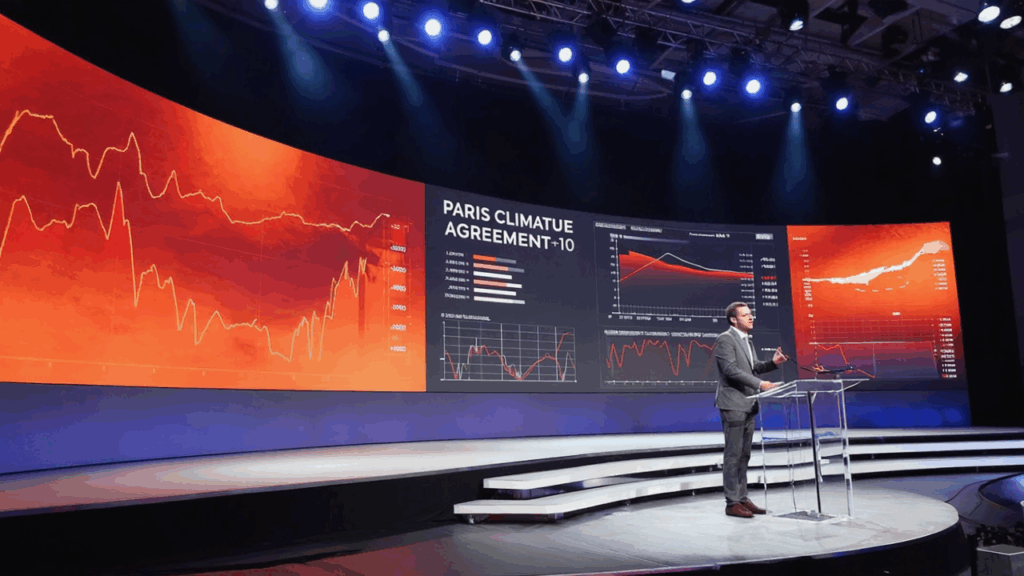
Paris Agreement at ten shows commitment gaps. Corporations need action partners for geopolitical uncertainty and climate adaptation strategies.
The Commitment-Action Chasm Widens
The Paris Agreement turns ten with mixed results. Current trajectories point toward 2.8-4.6°C warming by century’s end. This represents progress from the 3.5°C projected before Paris. Yet it falls drastically short of the 1.5°C goal. Most experts surveyed expect the 1.5°C threshold will be exceeded.
Recent OECD research surveyed 250+ policymakers and climate experts globally. Their assessment reveals stark realities for corporate strategists. One-third of signatory nations failed to update climate commitments. The United States withdrew from the Agreement for a second time. COP30 negotiations blocked critical fossil fuel phase-out roadmaps.
Survey respondents agree the Paris Agreement elevated climate as a priority. Without it, experts believe progress achieved before 2015 would have stalled. Yet confidence that current policies are sufficiently strong remains limited. Only 54% of policymakers express substantial confidence domestically. Fewer than 20% of climate experts see strong policies globally.
For corporations, this creates unprecedented strategic complexity across operations. Regulatory landscapes shift unpredictably across jurisdictions and political cycles. Supply chains face mounting physical climate risks in every region. Stakeholder expectations for climate action intensify regardless of policy volatility.
The gap between corporate commitments and operational transformation demands attention. Companies that declared ambitious net-zero targets now confront implementation realities. Board oversight of climate risks escalates amid growing litigation threats. Strategic partnerships become essential for navigating this demanding action-oriented phase.
Regulatory Uncertainty as the New Operating Reality
Paris +10 reveals fundamental instability in global climate governance frameworks. The Agreement established mechanisms like Loss and Damage Funds successfully. Carbon market rules under Article 6 finally gained operational clarity. New climate finance goals emerged from protracted negotiations at COP30. These advances represent significant diplomatic achievements over the past decade.
Yet enforcement mechanisms remain fundamentally weak across all these frameworks. Countries face no binding penalties for missing their stated targets. The International Court of Justice issued advisory opinions on climate obligations. These create moral pressure but lack direct enforcement power globally. Voluntary compliance dominates the international climate architecture even after ten years.
OECD research identifies critical barriers that impede progress toward Paris goals. Limited public funding emerges as the most important economic constraint. It captures 22% of expert prioritization and ranks first among 45% of policymakers. Vested interests opposing transition and lack of policy continuity across electoral cycles dominate institutional barriers. Together with resource constraints in government agencies, they account for 44-46% of institutional challenges.
For corporations, this creates strategic planning nightmares across global operations. European firms navigate the Corporate Sustainability Due Diligence Directive’s evolving requirements. North American operations face regulatory reversal risks with each political transition. Emerging market subsidiaries encounter divergent national implementation speeds and priorities. Asia-Pacific markets develop distinct approaches reflecting regional development priorities and constraints.
Four domestic policy challenges account for 82% of expert prioritization. Providing net-zero infrastructure ranks highest among implementation barriers identified. Inducing businesses to adopt clean technologies receives the strongest consensus. Increasing public acceptability of climate policies remains a critical hurdle. Making clean alternatives affordable for households completes this quartet of challenges.
The traditional approach of compliance-focused sustainability no longer suffices for operations. Companies must build resilient strategies that function across multiple scenarios. This requires sophisticated scenario planning that considers both policy acceleration and reversal. It demands operational flexibility to adapt to rapid regulatory changes. Static compliance programs become obsolete in this dynamic regulatory environment.
Boards increasingly face liability questions regarding climate risk disclosure accuracy. Legal frameworks now enable climate litigation against both states and corporations. Shareholders demand transparency on physical and transition risk exposures comprehensively. The business case for proactive climate strategy strengthens despite weakening mandates. Fiduciary duties evolve to encompass long-term climate risks explicitly.

Supply chain transformation emerges as the most complex implementation challenge. Agricultural commodity sourcing requires engagement with millions of smallholder producers. Manufacturing networks span jurisdictions with contradictory sustainability requirements and standards. Traceability systems must deliver credible data despite fragmented oversight structures. Digital technologies enable verification but require substantial investment across networks.
Disclosure requirements multiply across jurisdictions without harmonization or consistency emerging. Financial regulators impose climate risk reporting in fragmented ways globally. Stock exchanges develop competing sustainability listing requirements and verification standards. Rating agencies apply inconsistent methodologies to assess corporate climate performance. Companies face mounting costs without clear guidance on prioritization.
Geopolitical Fragmentation Reshapes Climate Business Strategy
The Paris Agreement assumed multilateral cooperation would strengthen over time predictably. Instead, geopolitical tensions now directly impact corporate climate strategies every day. Energy security concerns drive nations toward contradictory policy directions simultaneously. The climate transition becomes a site of great power competition.
Expert assessments confirm the Paris Agreement’s superiority over its predecessor framework. Between 76-79% of experts agree emission targets are stronger than under Kyoto. Between 68-76% believe current emissions are lower than they would be otherwise. The Agreement proves more effective at mainstreaming climate action at 72-75% agreement. It better secures public support at 71-72% agreement among surveyed experts.
China dominates clean energy manufacturing capacity and critical mineral supplies completely. This creates strategic dependencies that many nations now seek to reduce. Reshoring initiatives conflict with cost optimization and emissions reduction goals directly. Companies face impossible trade-offs between geopolitical risk and climate performance daily. Supply chain diversification increases costs while potentially increasing overall emissions profiles.
Trade policies increasingly weaponize climate standards as competitive tools between nations. The EU Carbon Border Adjustment Mechanism comes as an illustrative attempt to force global supply chain adjustments. Other jurisdictions threaten retaliatory measures against perceived green protectionism actively. Corporations navigate fragmented standards without global harmonization in sight currently. Bilateral trade agreements develop distinct climate provisions creating additional complexity layers.
Investment decisions require rigorous assessment of physical climate risks across decades. Facility locations chosen today will face dramatically different climate conditions tomorrow. Agricultural sourcing regions experience unprecedented weather volatility and devastating crop failures. Coastal infrastructure confronts accelerating sea level rise and storm intensification yearly. Infrastructure investments made now must remain viable through climate scenarios.
Water stress emerges as a critical constraint across manufacturing operations globally. Competing demands for agricultural, industrial, and municipal water intensify every year. Companies must secure water rights and develop circular systems proactively now. Supply chain dependencies on water-intensive processes require urgent evaluation and redesign. Groundwater depletion accelerates in key manufacturing and agricultural regions worldwide.
The insurance industry’s retreat from high-risk zones signals hard market reality. Properties become uninsurable in fire-prone and flood-vulnerable areas increasingly rapidly. This impacts real estate valuations and operational continuity planning very fundamentally. Corporate risk management must evolve beyond traditional insurance-dependent approaches entirely now. Self-insurance and alternative risk transfer mechanisms become necessary in vulnerable zones.
Talent acquisition and retention face significant new climate-related dimensions in operations. Employees increasingly evaluate employers’ climate commitments before accepting job offers carefully. Younger generations demand authentic action beyond marketing campaigns and empty pledges. Corporate reputation depends on demonstrable progress on sustainability metrics reported transparently. Employee activism around climate issues rises within organizations across sectors.
Political instability linked to climate impacts creates additional operational risks ahead. Food and water shortages drive social unrest in vulnerable regions already. Migration pressures intensify as climate impacts make certain areas increasingly uninhabitable. Governments face legitimacy crises when unable to protect populations from impacts. Companies operating across borders must anticipate governance breakdowns in exposed regions.
Adaptation as Strategic Imperative Beyond Carbon Reduction
COP30 finally elevated adaptation to equal prominence with mitigation efforts globally. Countries agreed to triple adaptation finance flows by 2030 in principle. Indicators for measuring adaptation progress gained international acceptance and standardization finally. Yet adaptation remains severely underfunded relative to mounting climate impacts worldwide. The adaptation finance gap grows larger each year despite renewed commitments.
Expert consensus identifies policy intervention as the primary pathway to bridge gaps. Market-based instruments, regulations, and innovation support collectively deliver 61-67% of required progress. Market mechanisms capture 23-26% of expected contribution through taxes and trading schemes. Regulatory measures account for 21-24% while green innovation policies contribute 17-19%. Autonomous technological progress without policy support contributes only 11-12% of necessary change.
Corporations can no longer view climate strategy as purely emissions-focused anymore. Physical impacts already disrupt supply chains, operations, and market access regularly. Heat stress reduces worker productivity in manufacturing and construction sectors significantly. Extreme weather events cause facility damage and production interruptions frequently. Adaptation investments become as critical as mitigation for business continuity.
Energy sector transformation emerges as the highest priority among policy directions. Electrification, energy decarbonisation, and efficiency improvements account for 50-52% of expert priorities. Scaling up renewable energy scores highest in transformative potential above 3.8 out of 5.0. Phasing out fossil fuels in power generation also scores above 3.8. Investing in green infrastructure and protecting carbon sinks round out top transformative policies.
Adaptation investments generate tangible competitive advantages in climate-vulnerable regions currently operating. Drought-resistant agricultural sourcing secures long-term commodity supply stability very reliably. Heat-resilient infrastructure reduces operational disruptions and insurance costs quite significantly. Water recycling systems ensure production continuity amid growing scarcity constraints everywhere. Early movers capture market share as competitors struggle with climate vulnerabilities.
Ecosystem restoration delivers both adaptation and mitigation benefits for corporate operations. Nature-based solutions provide flood protection and temperature regulation very cost-effectively. Regenerative agriculture improves soil health while sequestering atmospheric carbon over time. Biodiversity conservation maintains ecosystem services that underpin supply chains quite fundamentally. Natural capital investments yield multiple returns across environmental and financial dimensions.
Yet adaptation strategy development requires specialized capabilities most companies lack internally. Climate risk modeling demands sophisticated scenario analysis and fine geographic precision. Supply chain vulnerability assessment requires ground-level intelligence across many diverse regions. Implementation depends on local partnerships with credible community engagement experience proven. Technical expertise must combine with cultural competence in vulnerable communities.
The business case for adaptation strengthens measurably as physical risks materialize. Avoided costs from disruption prevention exceed adaptation investment requirements very significantly. First-mover advantages accrue to companies with climate-resilient supply networks already established. Market access expands in regions where competitors face mounting operational challenges. Insurance costs decrease for companies demonstrating effective risk reduction measures proactively.
Adaptation also creates substantial new market opportunities for forward-thinking companies today. Climate services demand grows across vulnerable sectors and geographies very rapidly. Resilient infrastructure solutions command premium pricing in high-risk markets successfully consistently. Technology platforms enabling adaptation decisions at scale attract substantial investment capital. Agricultural technologies for climate stress drive innovation across the food sector.
Integration between adaptation and mitigation strategies optimizes investment returns across portfolios. Energy-efficient cooling systems reduce emissions while managing heat stress impacts simultaneously. Green infrastructure provides carbon sequestration alongside flood and heat management benefits. Circular economy models reduce resource dependency while building supply chain resilience. Holistic approaches deliver synergies that siloed strategies cannot achieve alone.
Community engagement becomes essential for effective adaptation in sourcing regions worldwide. Local knowledge identifies vulnerabilities and solutions that external experts typically miss. Participatory approaches build trust and ensure interventions address real community needs. Economic benefits shared equitably strengthen long-term partnership sustainability and resilience. Companies that invest in community adaptation secure reliable supply over decades.
Conclusion: Partnership for the Action Era
Paris +10 confirms that the commitment phase concluded without delivering necessary results. The action era demands fundamentally different capabilities than pledge-making ever required. Companies need strategic partners designed specifically for navigating implementation complexity successfully.
Survey data reveals the confidence gap that companies must navigate going forward. Agreement that policies will be stringent by 2040 rises to 70-83% with Paris. Without the Agreement, this confidence drops to just 45-51% among experts surveyed. The ratchet mechanism and peer pressure prove essential for maintaining climate ambition. Yet voluntary action and behavioral change alone contribute only 21-27% of needed progress.
Ksapa combines strategic advisory, impact investment, and advocacy capabilities for transformation. We bring 25 years of sustainability transformation experience across G20 markets. Our expertise spans supply chain resilience, regulatory compliance, and just transition. We understand how climate strategy intersects with geopolitical and operational realities.
The next decade will separate climate leaders from laggards quite definitively. Those who move decisively will capture competitive advantages in resilient markets. Those who delay will face escalating costs and diminishing strategic options. Market dynamics reward early movers with stronger positions and better valuations.
Strategic clarity requires understanding how climate intersects with all operational realities. Implementation demands partners who combine deep sectoral expertise with geographic intelligence. Ksapa stands ready as your sparring partner for this decisive decade. We translate commitments into measurable outcomes across complex operating environments successfully.
Our integrated approach addresses the full spectrum of climate challenges today. We help navigate regulatory uncertainty across multiple jurisdictions and political cycles. We build climate-resilient supply chains that withstand physical and transition risks. We develop adaptation strategies that protect operations while creating competitive advantages.
We engage stakeholders from boardrooms to farming communities across supply chains. Our impact investment platform deploys capital for scalable sustainability transformation projects. Our advocacy work shapes policy frameworks that enable business climate action. This integrated model delivers results that advisory-only approaches cannot achieve alone.
Contact us to develop your action-oriented climate strategy for Paris +10. Together, we transform commitments into measurable, resilient operational outcomes that work. The action era rewards those who move beyond pledges to execution. Let us serve as your strategic partner in this critical transition.
Credit: Runway

Président et Cofondateur. Auteur de différents ouvrages sur les questions de RSE et développement durable. Expert international reconnu, Farid Baddache travaille à l’intégration des questions de droits de l’Homme et de climat comme leviers de résilience et de compétitivité des entreprises. Restez connectés avec Farid Baddache sur Twitter @Fbaddache.